• 11 Mar

    guiA Graphical User Interface (GUI for short) allows users to interact with the computer hardware in a user friendly way.

    Over the years a range of GUI’s have been developed for different operating systems such as OS/2, Macintosh, Windowsamiga, Linux, Symbian OS, and more.

    We’ll be taking a look at the evolution of the interface designs of the major operating systems since the 80’s.

    I should mention that this article showcases only the significant advances in GUI design (not operating system advances) and also not all of the graphical user interfaces and operating systems existing today.

    The first GUI was developed by researchers at Xerox Palo Alto Research Center (PARC) in the ’70s. This research opened a whole new era of computer graphic innovations.

    The first personal computer which used a modern graphical user interface was the Xerox Alto, developed in 1973. This was not a commercial product and was intended mainly for research at universities.
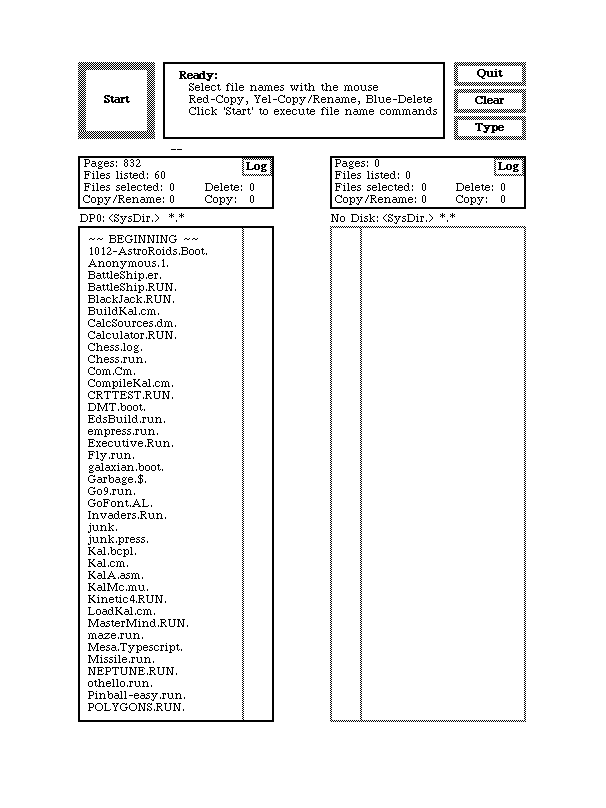
    1Source: toastytech.com


    1981-1985

    Xerox 8010 Star (released in 1981)

    This was the first system that was referred to as a fully integrated desktop computer including applications and a GUI. It was known as “The Xerox Star”, later renamed “ViewPoint” and later again renamed to “GlobalView”.
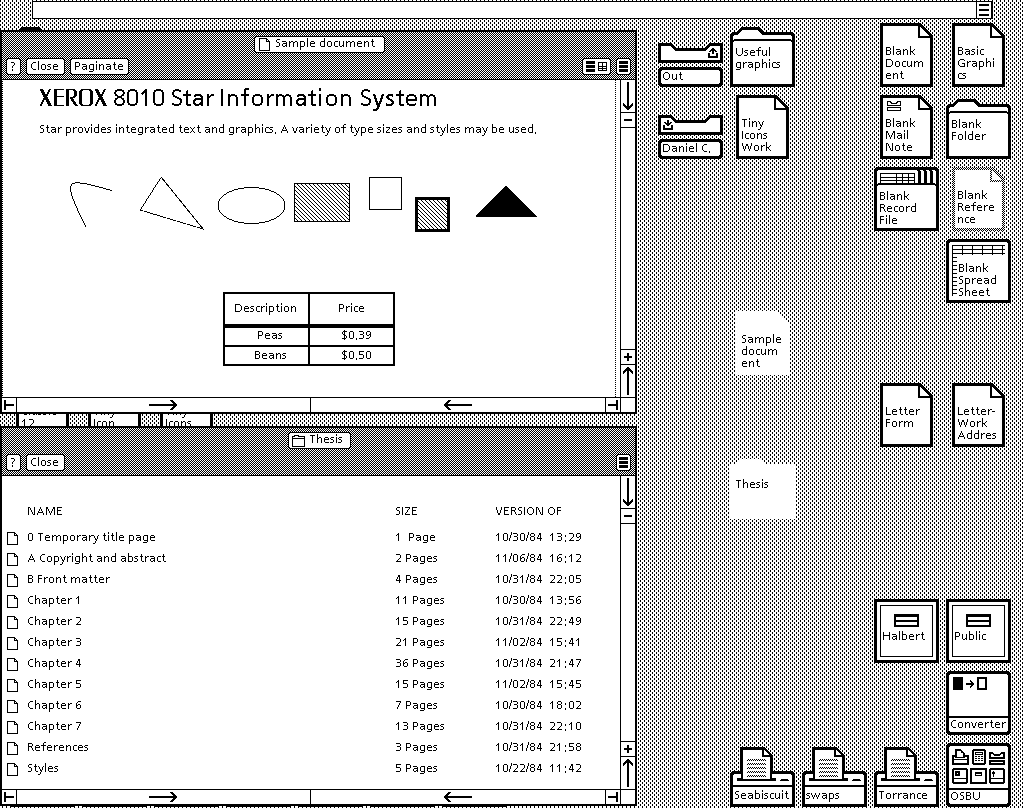
    Xerox 8010 Star
    Xerox 8010 Star, Source: toastytech.com


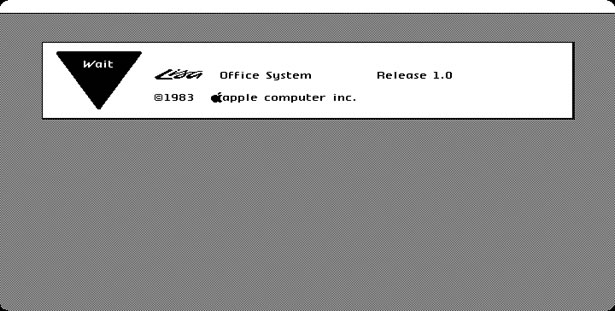
    Apple Lisa Office System 1 (released in 1983)

    Also referred to as Lisa OS, which in this case is short for Office System. It was developed by Apple with the intention of being a document processing workstation.

    Unfortunately this workstation didn’t last, it was killed by Apple’s Macintosh operating system that was more affordable.

    There were upgrades to Lisa OS, Lisa OS 2 in 1983 and Lisa OS 7/7 3.1 in 1984, that upgraded the system itself, but not the graphical user interface.
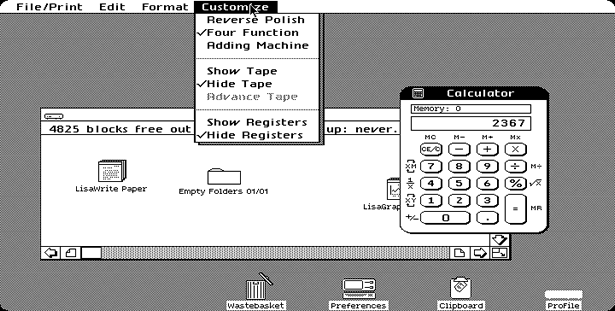
    Apple Lisa 1
    Apple Lisa OS 1, Source: GUIdebook


    Apple Lisa OS 1
    Apple Lisa OS 1, Source: GUIdebook


    VisiCorp Visi On (released in 1984)

    Visi On was the first desktop GUI developed for the IBM PC. This system was targeted towards big corporations and came with a high price tag. The GUI made use of a mouse, it had a built-in installer and help system and it didn’t use icons.
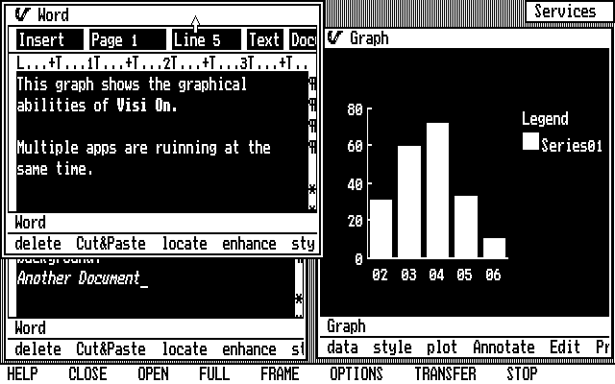
    Visi On
    VisiCoprt Visi On, Source: toastytech.com
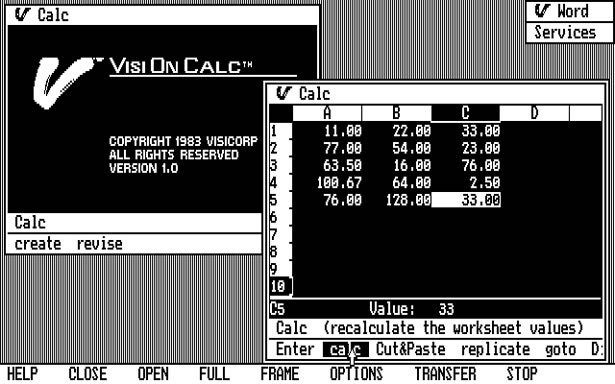

    Visi On
    VisiCoprt Visi On, Source: toastytech.com


    Mac OS System 1.0 (released in 1984)

    System 1.0 was the first operating system GUI developed for the Macintosh. It had several features of a modern operating system, being windows based with icons. The windows could be moved around with the mouse and files and folders could be copied by dragging and dropping onto the target location.
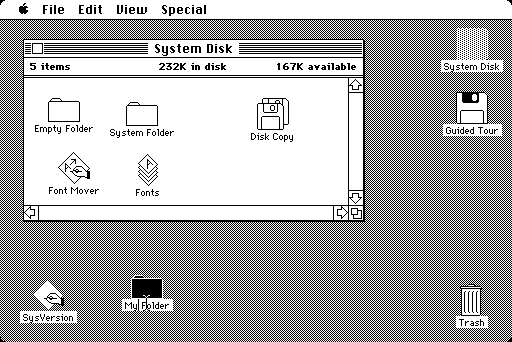
    Mac OS 1
    Apple Mac System 1.0, Source: toastytech.com


    Amiga Workbench 1.0 (released in 1985)

    When first released, Amiga was ahead of its time. The GUI included features such as color graphics (four colors: black, white, blue, orange), preemptive multitasking, stereo sound and multi-state icons (selected and unselected).
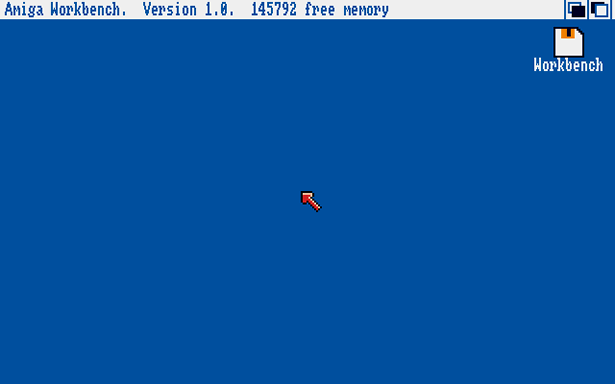
    Amiga Workbench 1.0
    Amiga Workbench 1.0, Source: GUIdebook
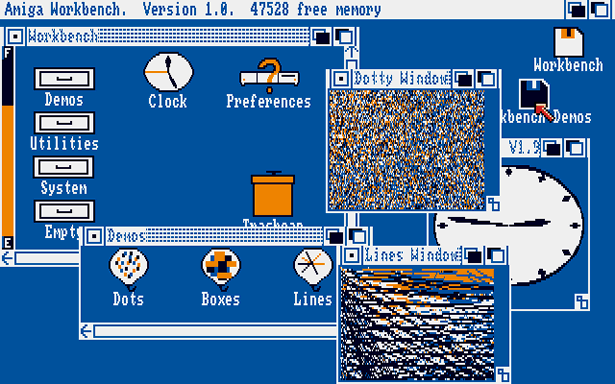

    Amiga Workbench 1.0
    Amiga Workbench 1.0, Source: GUIdebook


    Windows 1.0x (released in 1985)

    In this year Microsoft finally caught up with the whole graphical user interface craze and released Windows 1.0, its first GUI based operating system (although no one would dare to refer to it as one). The system featured 32×32 pixel icons and color graphics. The most interesting feature (which later was omitted) was the icon of the animated analog clock.
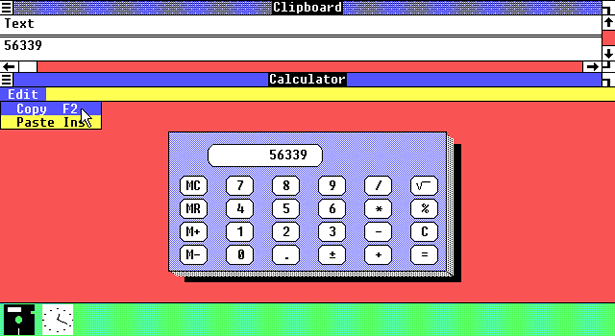
    Windows 1
    Microsoft Windows 1.01, Source: makowski-berlin.de
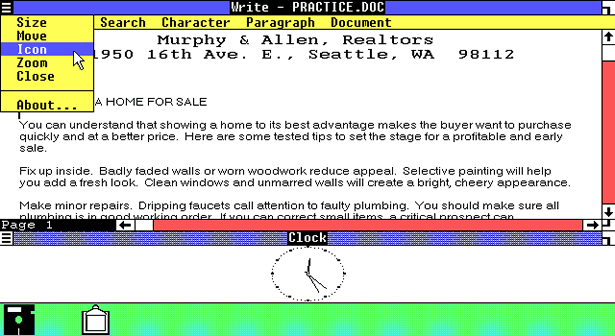

    Windows 1
    Microsoft Windows 1.01, Source: makowski-berlin.de


    GEM (released in 1985)

    GEM (Graphical Environment Manager) was a windowing style GUI created by Digital Research, Inc. (DRI). It was initially created for use with the CP/M operating system on the Intel 8088 and Motorola 68000 microprocessors and was later developed to run on DOS as well. Most people will remember GEM as the GUI for the Atari ST computers. It was also used on a series Amstrad’s IBM compatible computers. It was the core for Ventura Publisher and a few other DOS programs. The GUI was also ported to other computers but did not gain popularity on them.
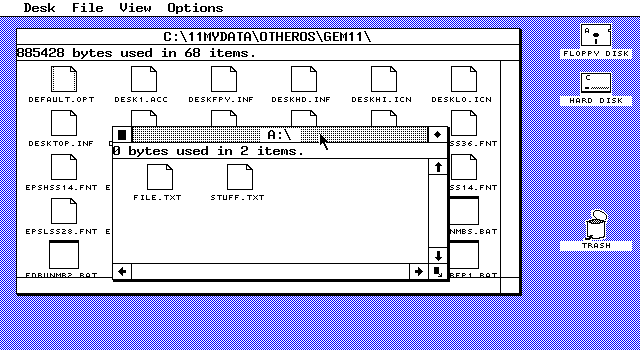
    gem_11_desktop1
    Source: Wikipedia


    1986 – 1990

    IRIX 3 (released in 1986, first release 1984)

    The 64-bit IRIX operating system was created for UNIX. An interesting feature of this GUI is the support for vector icons. This feature was built into the GUI long before Mac OS X even existed.
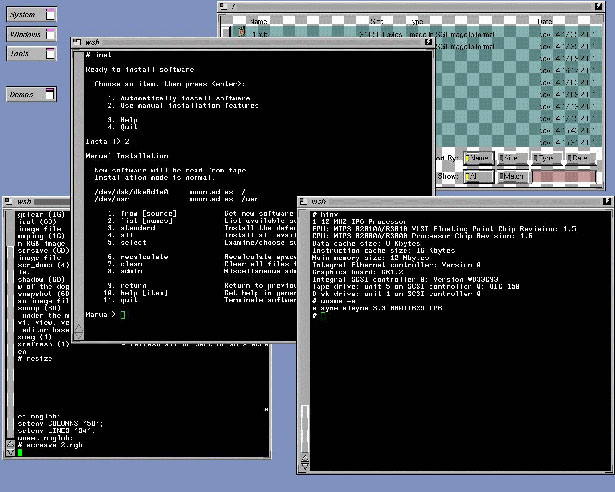
    irix-33
    Silicon Graphics IRIX 3.0, Source: osnews.com


    GEOS (released in 1986)

    The GEOS (Graphic Environment Operating System) operating system was developed by Berkeley Softworks (later GeoWorks). It was originally designed for the Commodore 64 and included a graphical word processor, called geoWrite and a paint program called geoPaint.
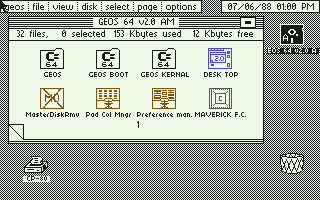
    geos_commodore_64
    Source: Wikipedia


    Windows 2.0x (released in 1987)

    In this version, the actual management of the windows had significantly improved. The windows could be overlapped, resized, maximized and minimized.
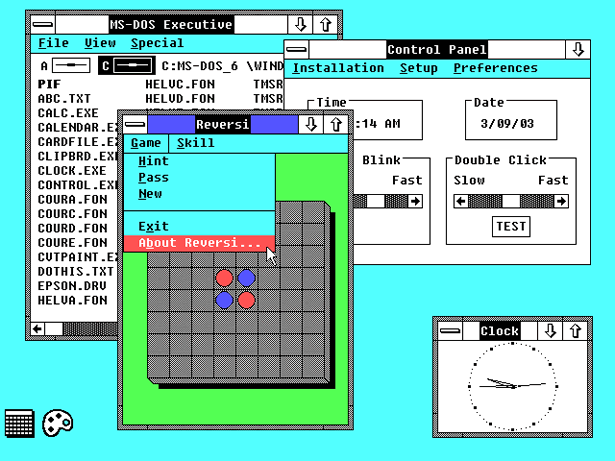
    Windows 2
    Microsoft Windows 2.03, Source: guidebookgallery.org
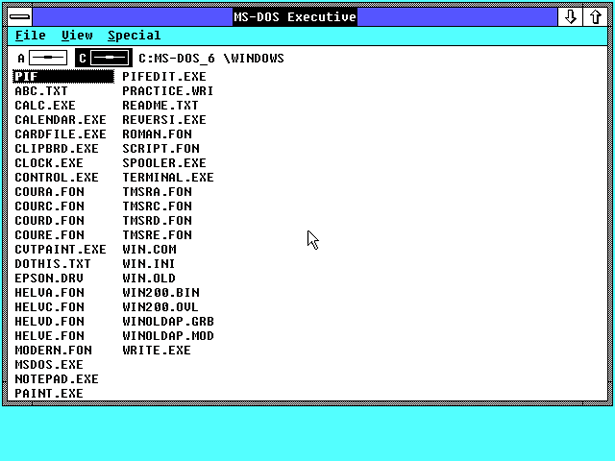

    Windows 2
    Microsoft Windows 2.03, Source: guidebookgallery.org


    OS/2 1.x (released in 1988)

    OS/2 was originally co-developed by IBM and Microsoft, but in 1991 the two companies split up, with Microsoft incorporating the technology in its own Windows GUI and IBM developing OS/2 further. The GUI used in OS/2 was called “Presentation Manager”. This version of the GUI only supported monochrome, fixed icons.
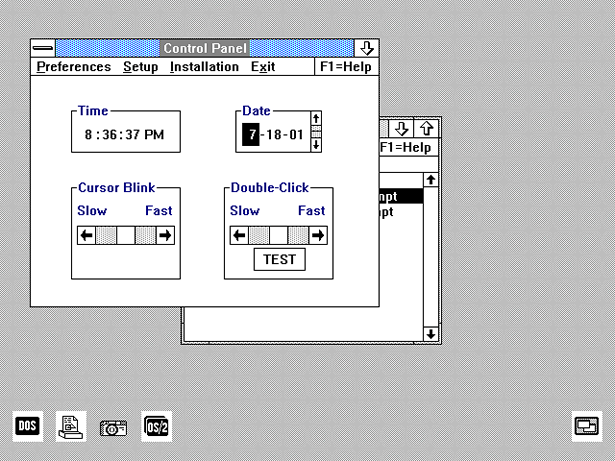
    Os 2 1
    Microsoft-IBM OS/2 1.1, Source: pages.prodigy.net
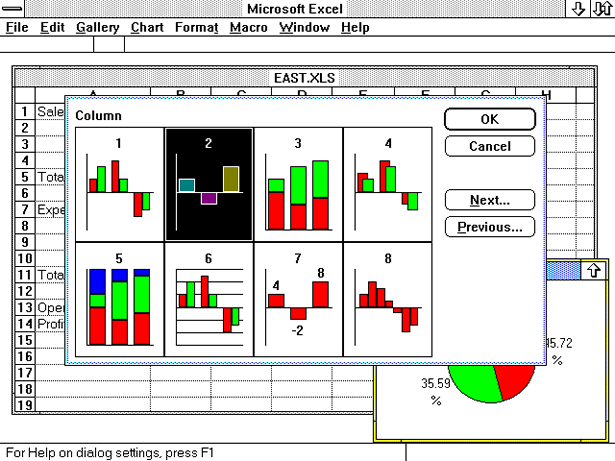

    Os/2 1
    Microsoft-IBM OS/2 1.1, Source: pages.prodigy.net


    NeXTSTEP / OPENSTEP 1.0 (released in 1989)

    Steve Jobs came up with the idea to create the perfect research computer for universities and research labs. This idea later evolved into a startup called NeXT Computer Inc.

    The first NeXT computer was released in 1988, however significant advances were made in 1989 with the release of the NeXTSTEP 1.0 GUI, which later evolved into OPENSTEP.

    The GUI’s icons were bigger (48×48) and it introduced more colors. The GUI was initially monochrome, but version 1.0 started supporting color monitors too. This screenshot gives you have a peek into what would become the modern GUIs.
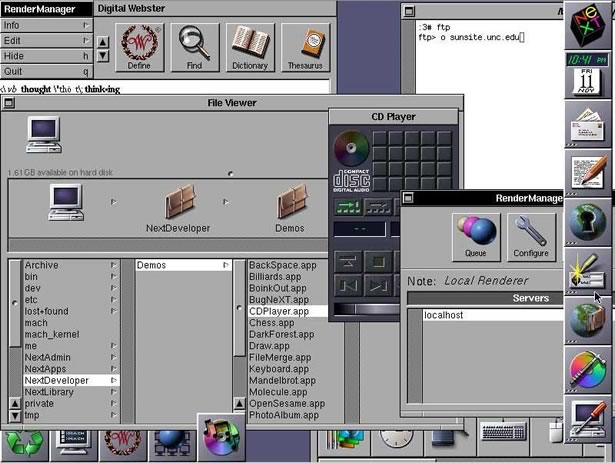
    Nextstep 1
    NeXTSTEP 1.0, Source: kernelthread.com


    OS/2 1.20 (released in 1989)

    The next minor version upgrade of the GUI showed slight improvements in many areas. The icons looked nicer and the windows were smoother.
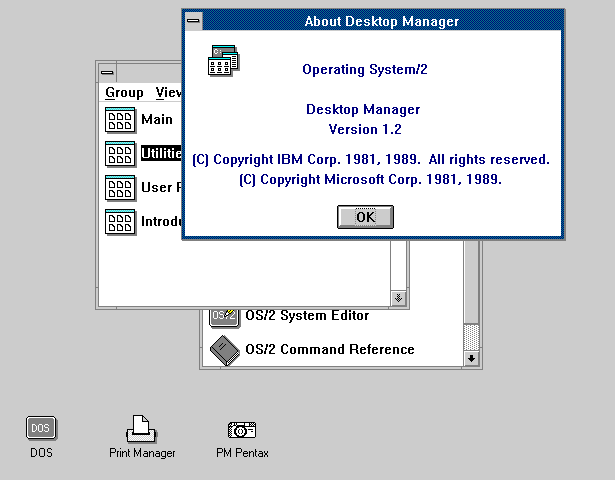
    Os 2 12
    OS/2 1.2, Source pages.prodigy.net


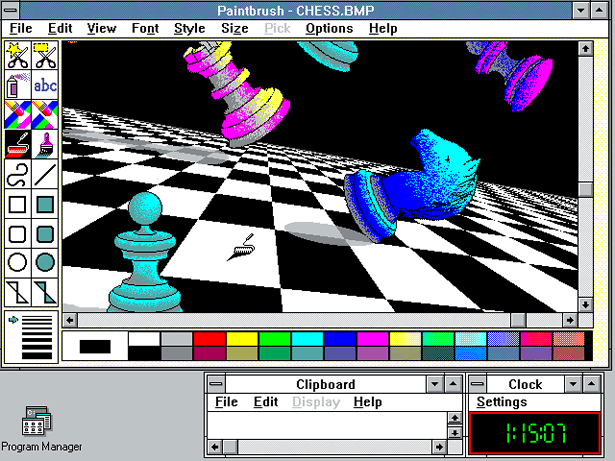
    Windows 3.0 (released in 1990)

    By this version, Microsoft had realized the real potential in GUI’s and started to significantly improve them.

    The operating system itself supported standard and 386 enhanced modes, which made use of higher memory capacity than 640 KB and hard disk space, resulting in the ability to use higher screen resolutions and better graphics, such as Super VGA 800×600 and 1024×768.

    Also, Microsoft hired Susan Kare to design the Windows 3.0 icons and to add a unified style to the GUI.
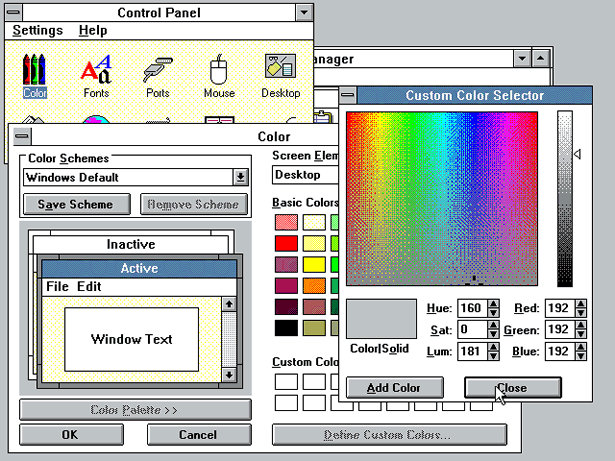
    Windows 3
    Microsoft Windows 3.0, Source: toastytech.com

    Windows 3
    Microsoft Windows 3.0, Source: toastytech.com


    1991 – 1995

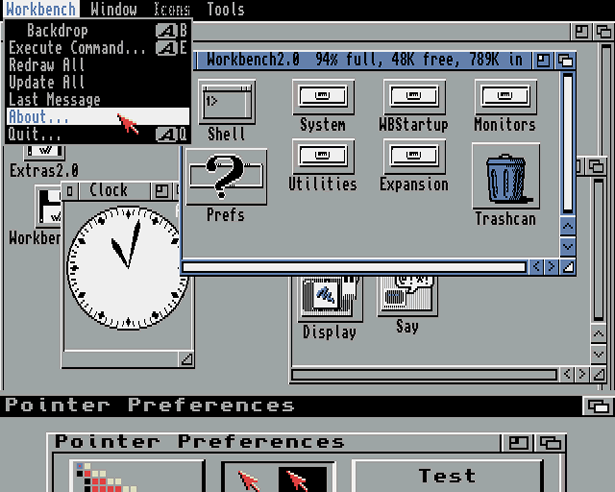
    Amiga Workbench 2.04 (released in 1991)

    Many improvements were made to this version of the GUI. The color scheme changed and a 3D look was introduced. The desktop could be divided vertically into screens of different resolutions and color depths, which nowadays seems a little odd. The default resolution of Workbench was 640×256, but the hardware supported larger resolutions too.
    Amiga Workbench 2
    Commodore Amiga Workbench 2.04, Source: guidebookgallery.org


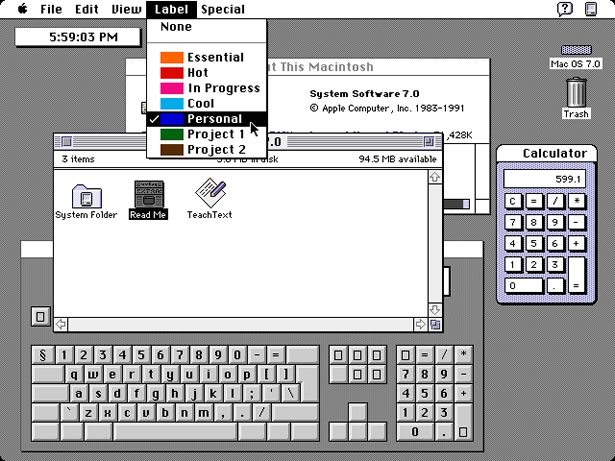
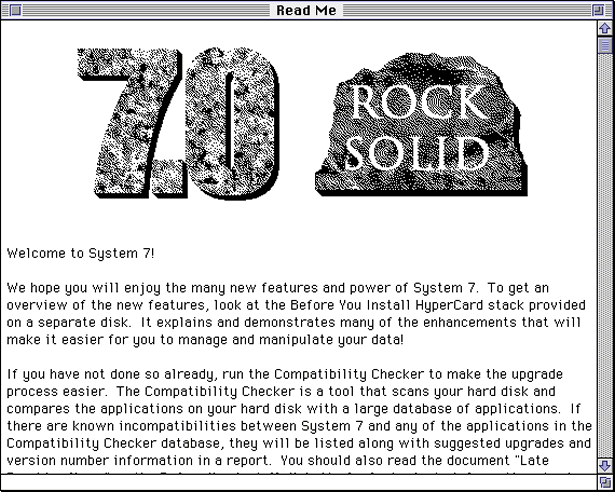
    Mac OS System 7 (released in 1991)

    Mac OS version 7.0 was the first Mac OS GUI which supported colors. Subtle shades of grey, blue and yellow were added to icons.
    Macos 7
    Apple Mac OS System 7.0, Source: guidebookgallery.org

    Macos 7
    Apple Mac OS System 7.0, Source: guidebookgallery.org


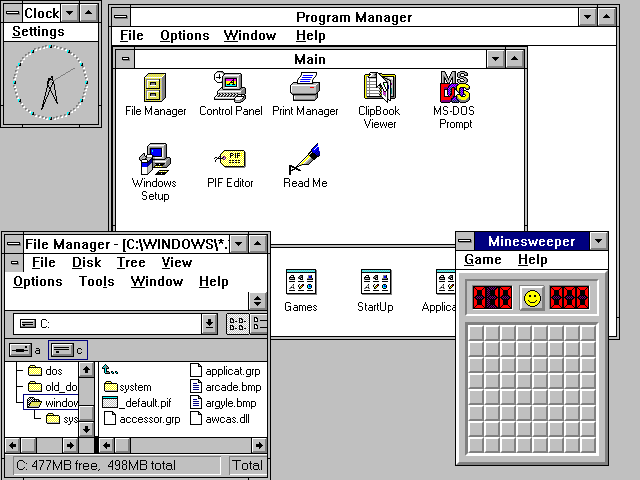
    Windows 3.1 (released in 1992)

    This version of Windows included TrueType fonts which were pre-installed. This effectively made Windows a functional desktop publishing platform for the first time.

    Previously, it was only possible to achieve such functionality in Windows 3.0 using the Adobe Type Manager (ATM) font system from Adobe. This version also contained a color scheme named Hotdog Stand, which contained bright hues of red, yellow and black.

    This color scheme was designed to help people with some degree of color blindness see text/graphics on the screen easier.
    windows_311_workspace
    Source: Wikipedia


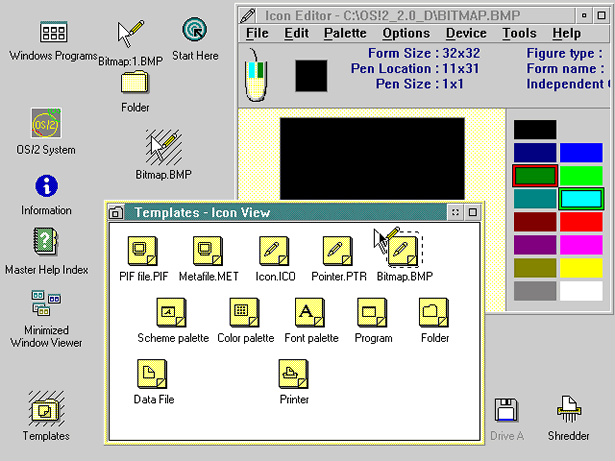
    OS/2 2.0 (released in 1992)

    This was the first GUI that was subjected to international acceptance, usability and accessibility testing. The entire GUI was developed using object-oriented design. Every file and folder was an object which could be associated with other files, folders and applications. It also supported drag and drop functionality and templates.
    Os 2 2
    IBM OS/2 2.0, Source: toastytech.com


    Os 2 2
    IBM OS/2 2.0, Source: toastytech.com


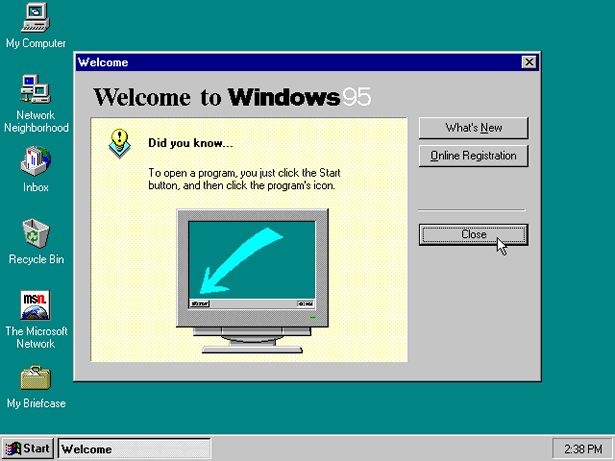
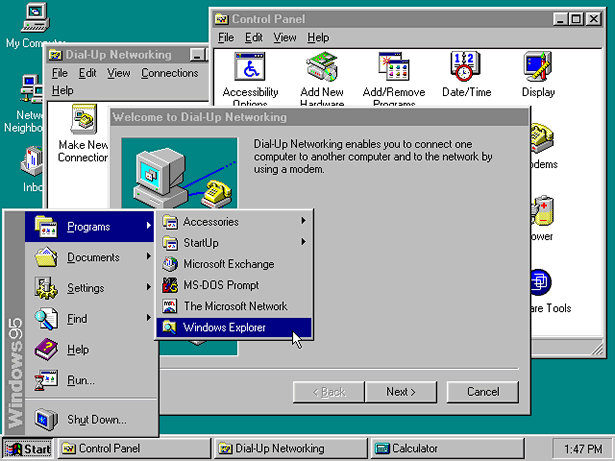
    Windows 95 (released in 1995)

    The user interface was completely re-designed since version 3.x. This was the first Windows version where a small close button was added to each window.

    The design team gave states (enabled, disabled, selected, checked, etc.) to icons and other graphics. The famous Start button appeared for the first time.

    This was a huge step forward for Microsoft regarding the operating system itself and the unified GUI.
    Windows 95
    Microsoft Windows 95, Source: guidebookgallery.org

    Windows 95
    Microsoft Windows 95, Source: guidebookgallery.org


    1996 – 2000

    OS/2 Warp 4 (released in 1996)

    IBM released OS/2 Warp 4 which brought a significant facelift to the workspace.

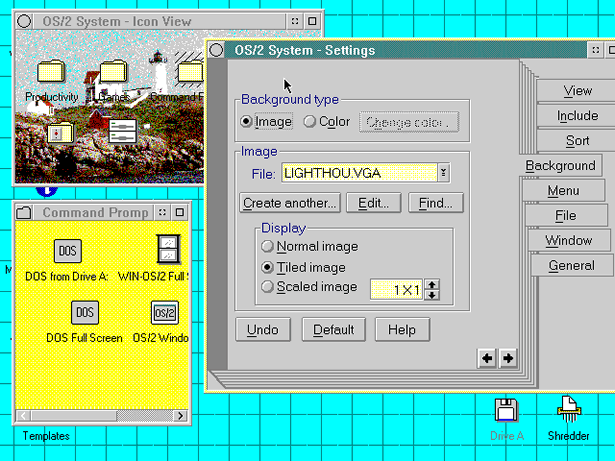
    Icons were placed on the desktop, where custom files and folders could also be created. The shredder appeared which was similar to Windows’ Recycle Bin or Mac OS’s Trash, except it deleted the file or folder instantly and didn’t store any additional copies for later retrieval.
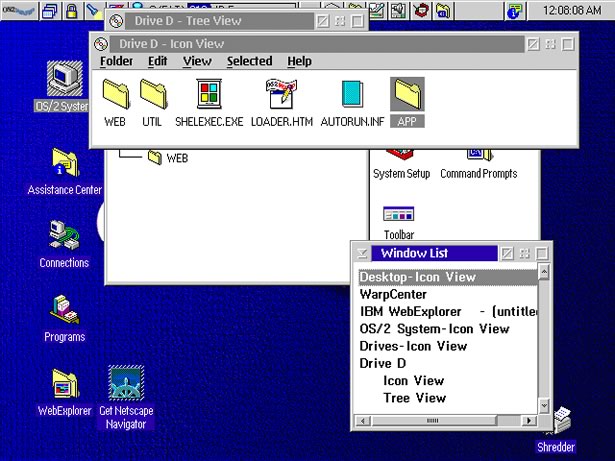
    Os 2 Warp 4
    IBM OS/2 Warp 4, Source: toastytech.com
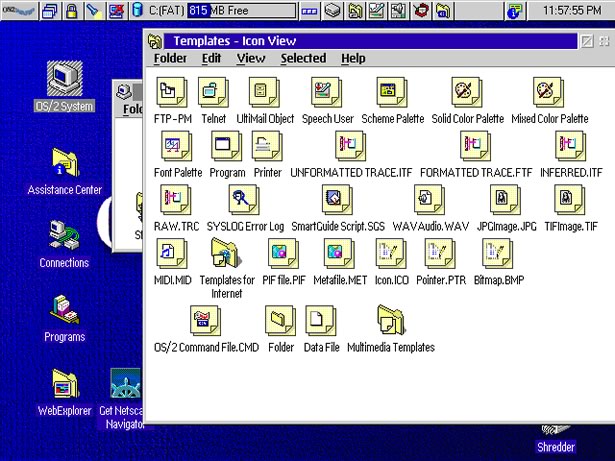

    Os 2 Warp 4
    IBM OS/2 Warp 4, Source: toastytech.com


    Mac OS System 8 (released in 1997)

    256 color icons were the default in this version of the GUI. Mac OS 8 was one of the early adopters of isometric style icons, also called pseudo-3D icons. The platinum grey theme used here became a trademark for future versions of the GUI.
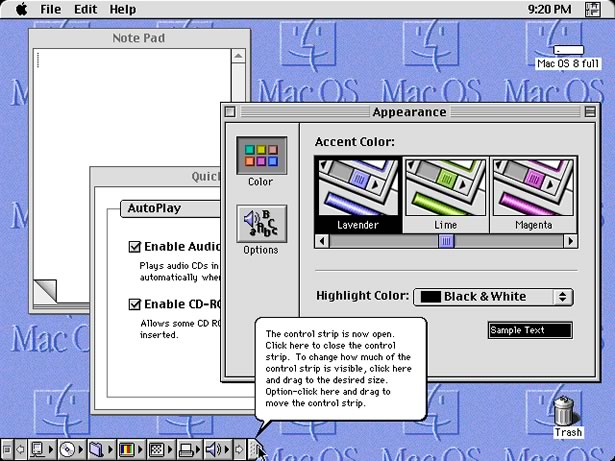
    Macos 8
    Apple Mac OS 8, Source: guidebookgallery.org


    Windows 98 (released in 1998)

    The icon styles were almost the same as in Windows 95, but the whole GUI could use more than 256 colors for rendering. Windows Explorer changed almost completely and the “Active Desktop” appeared for the first time.
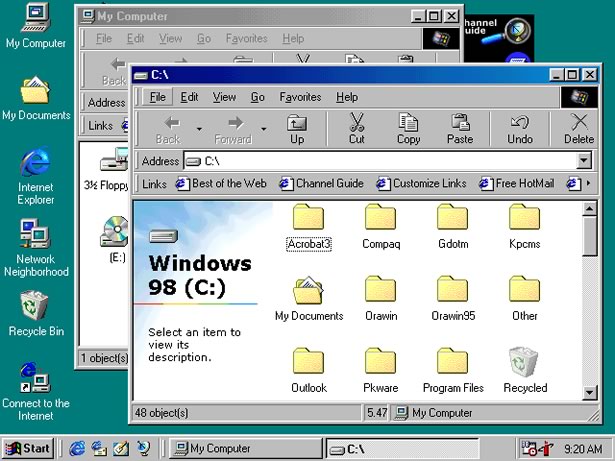
    Windows 98
    Microsoft Windows 98, Source: toastytech.com


    KDE 1.0 (released in 1998)

    This is how the KDE team described the project upon releasing version 1.0: “KDE is a network transparent, contemporary desktop environment for UNIX workstations. KDE seeks to fill the need for an easy to use desktop for Unix workstations, similar to the desktop environments found under the MacOS or Window95/NT. A completely free and open computing platform available to anyone free of charge including its source code for anyone to modify.”
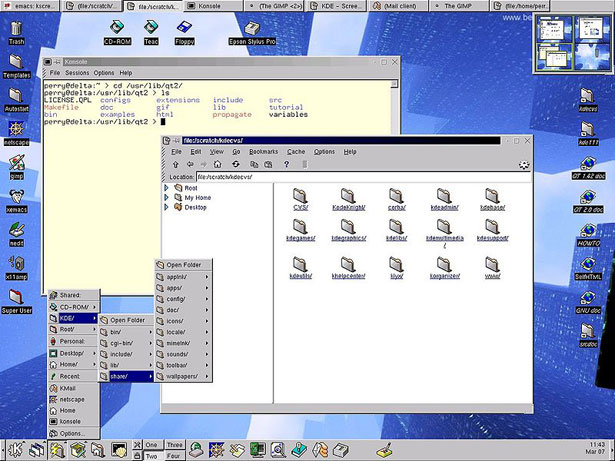
    800px-kde_10
    Source: Wikipedia


    BeOs 4.5 (released in 1999)

    The BeOS operating system was developed for personal computers. It was originally written by Be In in 1991 to run on BeBox hardware. It was later further developed to take advantage of newer technologies and hardware such as symmetric multiprocessing by utilizing modular I/O bandwidth, pervasive multithreading, preemptive multitasking and a custom 64-bit journaling file system known as BFS. The BeOS GUI was developed on the principles of clarity and a clean, uncluttered design.
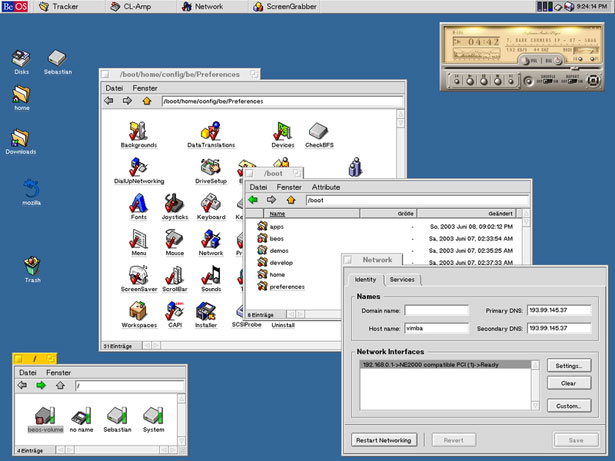
    800px-beos_desktop
    Source: Wikipedia


    GNOME 1.0 (released in 1999)

    GNOME desktop was mainly developed for Red Hat Linux, later it was developed for other Linux distributors as well.

    Gnome 1
    Red Hat Linux GNOME 1.0.39, Source: visionfutur.com


    2001 – 2005

    Mac OS X (released in 2001)

    In early 2000 Apple announced their new Aqua interface and in 2001 the company released it with their brand new operating system called Mac OS X.

    The default 32 x 32 and 48 x 48 icons were changed to big 128 x 128 anti-aliased and semi-transparent icons.

    Lots of criticism followed after the release of this GUI. Apparently users were not quite ready for such a big change, but soon enough they adopted the new style and today this GUI represents the basis of all Mac OS X operating systems.
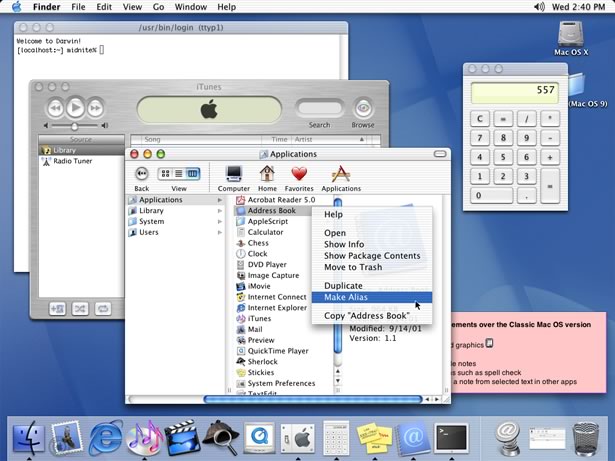
    Mac osx 1
    Apple Mac OS X 10.1 Source: guidebookgallery.org


    Windows XP (released in 2001)

    As Microsoft tends to change their GUI completely with every major operating system release, Windows XP was no exception. The GUI itself is skinnable, users could change the whole look and feel of the interface. The icons were 48 x 48 in size by default, rendered in millions of colors.
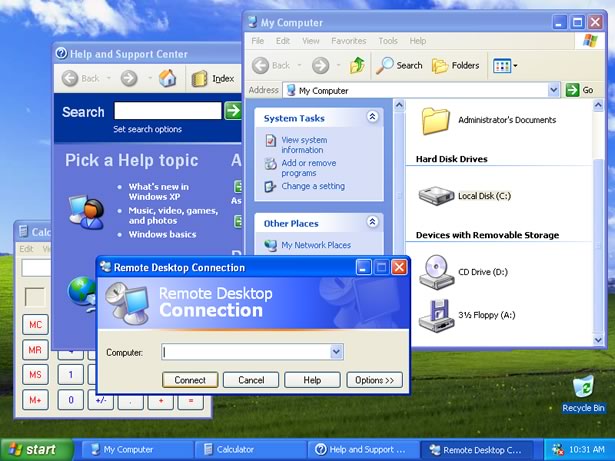
    Windows xp
    Microsoft Windows XP Professional, Source: guidebookgallery.org


    KDE 3 (released in 2002)

    Since version 1.0, the K Desktop Environment improved significantly. They polished all the graphics and icons and unified the whole user experience.

    Kde 3
    KDE 3.0.1, Source: netbsd.org


    2007 – 2009 (current)

    Windows Vista (released in 2007)

    This was Microsoft’s response to their competition. They also included quite a lot of 3D and animation. Since Windows 98, Microsoft has always tried to improve the desktop. With Windows Vista they released widgets and a somewhat improved replacement of the Active Desktop.

    Windows Vista
    Microsoft Windows Vista, Source: technology.berkeley.edu


    Mac OS X Leopard (released in 2007)

    With their 6th generation, Mac OS X system Apple, once again improved the user interface. The basic GUI is still the Aqua with its candy scroll bars and platinum grey, blue colors. The new GUI features a more 3D look, with the 3D dock and lots more animation and interactivity.

    Mac osx Leopard
    Apple Mac OS X 10.5 Leopard, Source: skattertech.com


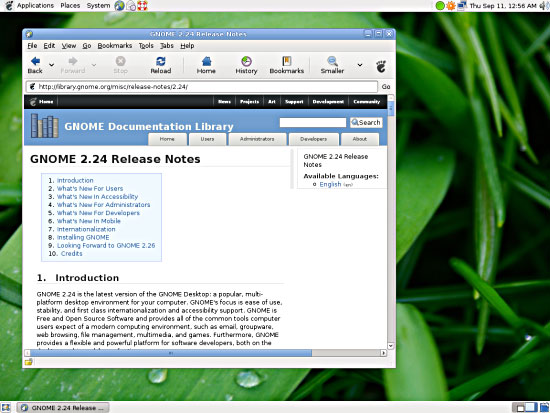
    GNOME 2.24 (2008)

    GNOME put a lot of effort into creating the themes and artwork into v2.2.4 as their aim is “to make your computer look good”. They ran a competition to collect some of the most intruiging desktop backgrounds that their contributors have produced for use in v2.24.
    gnome_en_gb
    Source: gnome.org

    KDE (v4.0 Jan. 2008, v4.2 Mar. 2009)

    Version 4 of K Desktop Environment produced many new improvements to the GUI such as animated, smooth, efficient window management and support for desktop widgets. The icons size are easily adjustable and almost every design element is much easier to configure. Some of the most noticeable changes include new icons, themes and sounds, which are provided by the Oxygen Project. These icons are more photorealistic. It is definitely a big improvement to the earlier versions of KDE. It can now also be run on Windows and Mac OS X platforms.

    kde
    Source: Wikipedia


    Acknowledgments

    Written and compiled exclusively for WDD by Gyorgy Fekete.

    What do you think of the evolution of these designs? What other improvements would you like to see? Please share with us…


  • 301 Comments »

     
    #1
    GRBlog
    March 11th, 2009 at 4:33 pm

    Wow…
    Algunos ni los habia sentido nombrar !!!
    Saludos,
    Gabriel


    #2
    Lieve
    March 11th, 2009 at 4:34 pm

    Hell yeah, awesome timeline. Retro interfaces rock


    #3
    Meghan
    March 11th, 2009 at 4:35 pm

    hahahahah! I remember that chess img and paintbrush. Old school to the max right there.

     
    1 Reply
     
    #4
    vertikal
    March 11th, 2009 at 4:39 pm

    HAHAH, great Post,
    THE most amaizing is that my grand parents still use 16 year old PC with Windows 3.11 to run their small company.
    I don’t know how come the computer still works. even the hard drive never failed.


    #5
    Michael
    March 11th, 2009 at 4:40 pm

    Things have really come a long way in the last 3 decades.


    #6
    daniel lopes
    March 11th, 2009 at 4:58 pm

    apple os x leopard interface rocks, much more cleanner than vista and still more slick.

     
    1 Reply
     
    #7
    plechi
    March 11th, 2009 at 4:59 pm

    nice


    #8
    Branden
    March 11th, 2009 at 5:03 pm

    Looks like Microsoft was pwning visually with Windows 95 until 2001 when Mac OS X dropped IMO. After that windows remained relatively the same. Visually Vista just looks like eye candy but with less functionality than OS X. Hopefully Windows 7 packs some more usefulness besides what’s been revealed so far because Vista is already relatively solid performance wise for me.


    #9
    Naldz Graphics
    March 11th, 2009 at 5:06 pm

    Pretty cool evolution:) great post:)


    #10
    Andrew France
    March 11th, 2009 at 5:08 pm

    Those bring back memories! Although it does seem unquestioned that the window model is the best we can do, I don’t quite see how overlapping windows and having to move them about the desktop has ever been useful. I always work in everything full screen, although I suppose a tiling window manager might be useful.


    #11
    xabopi
    March 11th, 2009 at 5:16 pm

    Somewhere in the beginning I think there was something called GEM by digital research if my mempry does not fail me

    Am I right?

     
    2 Replies
     
    #12
    Can
    March 11th, 2009 at 5:28 pm

    I know I’m going to get burned for this… But I think all the improvements after Windows 95 are cosmetic more than anything..

    I would be perfectly satisfied with a Win 95 machine today.. (imagine how fast it would run.. assuming that it could run on multi-core 64-bit systems)

     
    2 Replies
     
    #13
    Ralph
    March 11th, 2009 at 5:37 pm

    Wow, just wow. I’m looking at IRIX 3 and Next and I’m thinking “Jeez, it looks like it took everyone else 5 years just to catch up to these.” Visually at least.

     
    2 Replies
     
    #14
    Joe Vains
    March 11th, 2009 at 5:52 pm

    Woaw… thanks for this awesome post… *nostalgy* ;)


    #15
    Patrick
    March 11th, 2009 at 5:59 pm

    Wow! Amazing how the GUI design has dramatically improved in less than 30 years! The oldest I’ve ever used here is the Windows 3.1 one.


    #16
    Vishesh Kumar
    March 11th, 2009 at 6:01 pm

    Don’t mind guys, but it’d be rather nice if you cared to include KDE 4 too. Really nice timeline, but without KDE 4, one tends to think that OSS interfaces are really backward, though in my view they aren’t so much.
    You’ve even missed out on updating Gnome to 2.24. Do I see an anti-OSS bias here?? :) Just kidding; really amazing collection nevertheless. :D

     
    1 Reply
     
    #17
    Jack
    March 11th, 2009 at 6:06 pm

    I wanted to write sth like this as well. But obviously you are quick. Also you could include something more about Windows 7. I had collected the logos for all versions of Windows as well which you didn’t mention in this.


    #18
    Liam
    March 11th, 2009 at 6:27 pm

    nice article, but why end with leopard, what about KDE 4.2? also what happened to gnome?

     
    1 Reply
     
    #19
    Anders Hesselbom
    March 11th, 2009 at 6:31 pm

    I am sure that the Amiga had “preemtive multitasking”, not “primitive multitasking” as stated here. Se preemption at Wikipedia.

     
    2 Replies
     
    #20
    Floris
    March 11th, 2009 at 6:46 pm

    OS9?

     
    1 Reply
     
    #21
    Marco
    March 11th, 2009 at 6:56 pm

    That’s really cool to see! Very complete article, the interfaces came a long way. Can’t wait for the future!


    #22
    tobi
    March 11th, 2009 at 7:07 pm

    WHOW!!!! Great list of GUI History!!!

    Awesome what happened in the past 25 Years!


    #23
    Pia
    March 11th, 2009 at 7:19 pm

    Wow I so remember all this from watching my dad work when I was a kid hahaha!! Thank God for evolution… I sincerely admire my dad for even being able to work in such conditions!! :p

     
    1 Reply
     
    #24
    totoloco
    March 11th, 2009 at 7:43 pm

    and kde4???

     
    1 Reply
     
    #25
    Navdeep
    March 11th, 2009 at 7:44 pm

    Amazing list.. everyone who uses a computer must see this!


    #26
    Rahul
    March 11th, 2009 at 7:55 pm

    I’d started using computer by starting MS Dos and currently I’m satisfied by Windows XP; I don’t like the new windows vista which is very resource hungry.


    #27
    Spaksu
    March 11th, 2009 at 8:27 pm

    Great post, but where is “PARDUS” (Turkish national operating system)

     
    1 Reply
     
    #28
    Skye
    March 11th, 2009 at 8:39 pm

    Where’s KDE 4.2? I’m guessing that it puts others to shame and therefore wasn’t included :D

    http://www.kde.org/announcements/4.2/

     
    1 Reply
     
    #29
    Richard
    March 11th, 2009 at 9:05 pm

    You missed Mac OS 9, which was a comparable difference between 8 and X.


    #30
    Soh
    March 11th, 2009 at 9:52 pm

    Some of the older interface color combos gave me quite a headache X-p

    Very interesting time line, thanks!


    #31
    Pascal Hartig
    March 11th, 2009 at 10:08 pm

    Amazing post. But I’m missing KDE 4 screens.

     
    1 Reply
     
    #32
    raymassie
    March 11th, 2009 at 11:22 pm

    Mac OS 9?


    #33
    Dave
    March 12th, 2009 at 12:49 am

    Where’s the 2009 Desktop Environments for Linux?

    Surely this wouldn’t be complete without the latest version of Gnome or at least KDE 4 which is a completely new revision of KDE.
    A mention of Compiz would also fit nicely here in advancements in user interfaces.

     
    2 Replies
     
    #34
    The Ancient One
    March 12th, 2009 at 1:02 am

    I remember them all.(sigh)
    ah to be young again- with not even a calculator in sight.


    #35
    Utah Dude
    March 12th, 2009 at 1:06 am

    A fascinating post! It’s amazing that you acquired all of these great images!


    #36
    Jeroen
    March 12th, 2009 at 1:32 am

    No RISC OS? (1988 – 2008)


    #37
    parsnips
    March 12th, 2009 at 1:32 am

    Irix is a Unix operating system made by SGI – not a graphical user interface
    Irix can run X Windows (which is what you are showing) and any Window Manager on top of it (there are lots, OpenStep, E, etc…)
    Same can be said for Solaris and Linux and FreeBSD
    You left out Compiz/Beryl, Looking Glass and a lot of other GUIs too

     
    1 Reply
     
    #38
    peter
    March 12th, 2009 at 1:40 am

    Nice — but no RISC OS? http://en.wikipedia.org/wiki/RISC_OS


    #39
    The Frosty @WPCult
    March 12th, 2009 at 1:41 am

    I remember playing the chess game!!


    #40
    Ragnar Þór Valgeirsson
    March 12th, 2009 at 2:21 am

    One of the most interesting articles I’ve read in a very long time!!


    #41
    Richard
    March 12th, 2009 at 2:41 am

    For those of you saying “OS9?”

    Its was the version release between Apple OS 8 and Apple OS X (X actually is pronounced Ten, its a roman numeral), anyways upon the release of OS X Apple redubbed OS 9 as Classic. There were a lot of graphical changes between 8 and 9, colorization really started there.


    #42
    nhek
    March 12th, 2009 at 3:17 am

    nice list – you could have also included BeOS (http://en.wikipedia.org/wiki/BeOS)

     
    2 Replies
     
    #43
    Kyderdog
    March 12th, 2009 at 3:44 am

    Kinda miss the Apple GS OS
    And Atari TOS and GEM..


    #44
    camelia
    March 12th, 2009 at 4:31 am

    First time i learn computer is using DOS. is it not an OS interface? coz it not in the list.

     
    1 Reply
     
    #45
    Javier
    March 12th, 2009 at 4:44 am

    One comment regarding the Amiga:

    It’s multitasking capacities were hardly primitive. The Amiga had fully pre-emptive mulltitasking, and it was the first “home OS” which had this feature. All other computers at that time had cooperative multitasking (one application freezes and the entire system freezes). PCs eventually caught up when Windows NT was introduced (8 years later), and in the case of Macs they had to wait a full 15 years before they had this capacity widely available to its users.

     
    2 Replies
     
    #46
    Snappy
    March 12th, 2009 at 5:31 am

    What about later GNOME releases?

    Also, I’m pretty sure the screenshot for IRIX was not for the release version in 1986. It probably reflects that found in 1990. This gives a skewed representation of how GUI evolved.

    1986 – 1990
    IRIX 3 (released in 1986, first release 1984)

     
    1 Reply
     
    #47
    Viktor
    March 12th, 2009 at 5:32 am

    Soft, warm nostalgic feelings about windows 3.11…


    #48
    Brandon
    March 12th, 2009 at 5:47 am

    Very cool blog post!

    Its neat to see how things started and then improved each release. I have to say that Apple has the best user interface yet…..and I have never owned a Mac at all! I plan on getting one this summer (Mac Book Pro).


    #49
    lowell
    March 12th, 2009 at 6:01 am

    you mention that NeXSTEP eventually evolved into OPENSTEP. that’s accurate, but you forgot to mention that from OPENSTEP, it further evolved into Mac OS X. the vast majority of the classes we use in both the AppKit and Foundation frameworks in Mac OS X are the same as those that were used for NeXTSTEP. even the class names remain, for instance, the string class is still named NSString in Mac OS X. Save for those using deprecated classes, anything written for NeXTSTEP using AppKit or Foundation is source compatible with Mac OS X and even GnuSTEP. Try that with Windows 3.11 and Windows 7.

    some of the apps from NeXTSTEP also made it to Mac OS X, like TextEdit, Mail.app and Terminal.app.

    NeXTSTEP was so far ahead of it’s time when it was first released, and now, 19 years later, is still one of the more advanced operating systems available.


    #50
    Stan
    March 12th, 2009 at 6:23 am

    How about a little mention of BeOS’s GUI (or ZETAs, Be’s former successor)?

    I think that GUI encompasses some ideas of modern design in addition to simplicity and customization :) .

     
    1 Reply
     
    #51
    Min Thu
    March 12th, 2009 at 7:14 am

    Very nice to see OS interfaces from old days! :)


    #52
    Zarlp
    March 12th, 2009 at 7:45 am

    Why have you left out the Graphical Environment Manager ?? http://en.wikipedia.org/wiki/Graphical_Environment_Manager


    #53
    Bob
    March 12th, 2009 at 8:05 am

    Ah… the memories. Excellent timeline, great to see those retro interfaces again. Left out BeOS and the later iterations of GNOME, though, and the shameless sucking up to apple in the latter end was unnecessary, but on the whole quite enjoyable. :)

    Also, reddit says ‘Hi.’

     
    1 Reply
     
    #54
    DK
    March 12th, 2009 at 8:36 am

    Wow…. This blog entry brings back lots of memories. (Some of them pretty unpleasant. haha)


    #55
    insic
    March 12th, 2009 at 8:54 am

    cool. do you guys still have this retro OS?


    #56
    Richard S Rumawas
    March 12th, 2009 at 8:56 am

    Nice simple and brief information.

    Thank you.


    #57
    Aaron
    March 12th, 2009 at 8:58 am

    OS X Tiger should have been included to fill the gap from the whole stagnation between the XP through the Vista (2001-2007) years


    #58
    loveleen
    March 12th, 2009 at 8:59 am

    Woah..!!
    brought back old memories dating back to windows 3.0..
    I still remember how much we would be struggling and getting excited over small drawings in mspaint dating a couple of decades before…
    and now it is so much better…and look at the progress now …within 20 years so much changed..


    #59
    Mehul Ved
    March 12th, 2009 at 9:18 am

    No mention of UI’s in cell phones and netbooks that have evolved with time. That would make an interesting addition to the article.


    #60
    Gyorgy
    March 12th, 2009 at 10:23 am

    Please guys, don’t confuse operating systems with graphical user interfaces.

    The article is all about the MAJOR GUI advances, and as I tried to emphasize in the beginning of this article that it won’t cover the whole range of GUIs from start to finish.


    #61
    boodle
    March 12th, 2009 at 10:51 am

    Read the source article of the IRIX 3 screenshot. It’s IRIX 6.5 from 1998.

    Here’s a pic of IRIX 3.x for you:
    http://home.arcor.de/gerhard.lenerz/images/Screenshots/irix-3.3-img2.gif

     
    1 Reply
     
    #62
    W.D
    March 12th, 2009 at 10:58 am

    Great post!
    The only thing missing is Gnome 2.x
    Gnome has improved since 1.0!

     
    1 Reply
     
    #63
    VesqS
    March 12th, 2009 at 11:02 am

    Nice try but as have been pointed out you missed few. GEOS for c64 should be there. Not very usable but graphical none the less. Also Evolution, XFCE and later Amiga OS’s (3 and 4 series) should be there.


    #64
    Syed Mohamed Ali. S
    March 12th, 2009 at 11:12 am

    Wonderful Compilation of the OS UIs. Really, it took me a long journey back in time when I saw the First GUI OS of my life (Win’98). Later I got introduced to Win 3.1, Win 95, Win NT 4.0 and then to Linux UIs (Suse, Redhat and then some other versions) within my College days itself.


    #65
    Flavio Copes
    March 12th, 2009 at 11:16 am

    Thanks for this voyage through history.. I especially liked the Amiga OS 2 part.. since it was my first computer.


    #66
    Ricardo
    March 12th, 2009 at 11:26 am

    Dude, you forgot geOS for the commodore 64.

    And where is Gnome 2?

    Worth noting: KDE and Gnome Desktop environments are extremely customizable, and there are TONS of better looking UI desings for them than the plain old OoB looks. To me that’s what makes them better. You can play mix and match between window frame decorations and controls skins.

     
    1 Reply
     
    #67
    NameRequired
    March 12th, 2009 at 11:57 am

    The Amiga had “primitive multitasking”? I guess you mean it didn’t have memory protection, but that was because the 68k didn’t have a memory management unit. It’s multitasking was not primitive – it was preemptive for instance, while Mac OS was cooperative, and that only changed when Mac OS X came out ~15 years later.

    And then later you say of Workbench 2.04:

    “Many improvements were made to this version of the GUI. The desktop could be divided vertically into screens of different resolutions and color depths, which nowadays seems a little odd. The default resolution of Workbench was 640×256, but the hardware supported larger resolutions too.”

    All of those features already existed in the original version of Workbench. (The most obvious change was the colour scheme and the 3D look, but they also added ARexx and rewrote it from BCPL to C.)


    #68
    nik
    March 12th, 2009 at 11:57 am

    The IRIX screenshot is 5.5 or 6.0 – its not the earlier IRIX (it even has Gimp in the screenshot which is a giveaway).

    Early IRIX looked like this:

    http://home.arcor.de/gerhard.lenerz/images/Screenshots/irix-3.3-img2.gif

    one of the more innovative GUI’s in that era without a doubt. Also, IRIX is a complete OS, not just a GUI.

     
    1 Reply
     
    #69
    Ahmed
    March 12th, 2009 at 12:27 pm

    A really nice presentation that tour us through Desktop computer evolution. It was such a sweat tour.
    Thanks.
    God speed to Human race!


    #70
    Zeb
    March 12th, 2009 at 1:03 pm

    Really awesome again post !! Remember yours OS, excellent…


    #71
    Jón Ragnarsson
    March 12th, 2009 at 1:24 pm

    Very nice. I miss Acorn Risc OS gui there, though.
    http://www.operating-system.org/betriebssystem/_english/bs-riscos.htm


    #72
    Vasi
    March 12th, 2009 at 1:26 pm

    Seriously, no way is the pic in the article IRIX from the ’80s. It looks like it’s running WindowMaker, which wasn’t released until ‘97. It shows CUPS, which didn’t exist until ‘99. And it mentions OpenGL, not released until ‘92.

     
    1 Reply
     
    #73
    theamoeba
    March 12th, 2009 at 1:26 pm

    very nice, interesting how the OS GUI has evolved over time in a relatively short space of time.

    my grandfather used windows 3.1 up to last year when he got ubuntu. ive still got a copy of windows 3.1 on stiffys, can you believe it :) .

    perhaps it would be fun to look at how CLI OSs evolved sometime :)


    #74
    Pitu
    March 12th, 2009 at 1:42 pm

    Nice post, thanks!

    But… Where are my MSX and Basic??? I supose they are not here… because they have no design! ;-)


    #75
    Joey Diggs
    March 12th, 2009 at 1:45 pm

    The Amiga had PREEMPTIVE multitasking, you cretin. For gosh sakes, what a stupid error.

    And no one with an Amiga kept their workbench like that. We all ran MagicWB or the like.

     
    1 Reply
     
    #76
    Jason
    March 12th, 2009 at 2:18 pm

    Awesome post…great to see the change in appearance and functinality over the years.


    #77
    Russell
    March 12th, 2009 at 2:22 pm

    Hey what about GEOS for the Commadore 64?

    http://en.wikipedia.org/wiki/GEOS_(8-bit_operating_system)

    I remember in the 90’s when my ancient pc died and i’d lent my apple classic to someone i had to trawl out the C64 with GEOS to type up a project. I hadn’t thought of that for years until just now..

    Russ

     
    1 Reply
     
    #78
    Fkrocker
    March 12th, 2009 at 2:54 pm

    What about the GEM?

     
    1 Reply
     
    #79
    venkat
    March 12th, 2009 at 2:58 pm

    Guess you missed Compiz!

     
    1 Reply
     
    #80
    Scott K
    March 12th, 2009 at 3:10 pm

    Great, great article. I never realized some of the interfaces from the 80’s had a pretty good look.


    #81
    bhindstein
    March 12th, 2009 at 3:49 pm

    Ok, I looked twice and did not see Windows 2000 or NT. Perhaps it is embedded in the XP listing?


    #82
    Sairuz
    March 12th, 2009 at 4:08 pm

    KDE4 is so Beautiful, love it


    #83
    Arm0
    March 12th, 2009 at 4:14 pm

    What about win2k? I love it!


    #84
    Keith Pickett
    March 12th, 2009 at 4:15 pm

    I think I see your point in this article. I was about to flame you for not including X-windows if you mentioned KDE, but you were specific to KDE4. KDE4 is driven by QT. So, I get it now. It’s a classic RTFA. However, I sort of question the MS Windows mention in this context. The earlier versions ran on top of DOS from what I understand. I guess it doesn’t really matter, it’s a good article to compare the differences between the GUIs too.


    #85
    blarg33
    March 12th, 2009 at 4:25 pm

    what no BeOS love??? guess everyone’s forgotten it…

     
    1 Reply
     
    #86
    Jones, Francisco
    March 12th, 2009 at 4:33 pm

    I agree Gyorgy.

    I see you have included no UNIX GUI as Motif, CDE, OpenWin, …
    This way, it looks as UNIX has never had GUI.


    #87
    dude
    March 12th, 2009 at 4:37 pm

    Me thinks you missed Amiga 3.0, BeOS, Commodore GeOS… And BTW Amgia was preemtive and mutliprocessor. Its a cool stroll, but kinda light on substance and how before windows dominated – advances went much much faster. Look how a different GUI came out just about each year – and each one was much improved over the previous ones…. with the MS monopoly – that’s all but been wiped out.


    #88
    Gary
    March 12th, 2009 at 5:06 pm

    I’m sure I’m not alone in saying that I was blissfully unaware of the advancements in the Unix world back in the mid eighties.

    I’m just old enough remember the command-line days before GUI.

    Great post.


    #89
    tAALz
    March 12th, 2009 at 6:00 pm

    Wow that was a nice resource ..
    I have written an article few days ago about the Windows Operating System since 1985.
    http://www.pickmore.com/microsoft/microsoft-windows-10-to-windows-seven-journey-1969


    #90
    Jamaal
    March 12th, 2009 at 6:15 pm

    Don’t forget to throw a modern Gnome in the last section. Through Ubuntu, that’s the desktop that most Linux users are seeing lately.


    #91
    mycroft
    March 12th, 2009 at 6:27 pm

    WHERE THE HELL IS PC GEOS OR GEOWORKS 2.0?

     
    1 Reply
     
    #92
    Rijandael Edok
    March 12th, 2009 at 7:04 pm

    I miss OS/2. It was the best of the best, a decade ahead of every other system. WHy oh why did IBM kill it?


    #93
    Geos
    March 12th, 2009 at 7:06 pm

    You did not include GEOS (Graphic Environment Opertating System) for the Commodore.

     
    1 Reply
     
    #94
    Talk Binary
    March 12th, 2009 at 7:24 pm

    Awesome timeline. The time and effort put into this article is amazing and it shows! Unfortunately I believe Microsoft blew it with Vista. Too much eye candy which bogged the system down. Still keeping XP!


    #95
    Ben
    March 12th, 2009 at 7:58 pm

    The whole thing completely skips over GS/OS for the Apple //gs

    I’m not sure how you could have made that error.


    #96
    Doug
    March 12th, 2009 at 8:20 pm

    I agree with Rijandael. OS/2 Warp was everything XP has and then some, 5 years ahead of XP and half the hardware requirement. I used both NeXTSTEP and OS/2 Warp would prefer either to Windows anything…


    #97
    Valeri Gladun
    March 12th, 2009 at 8:29 pm

    197? – CPM Power
    1980? – QNX
    198? – rusian Miss for PDP-11
    1982 – Lotus
    1984 – X11
    198? – DR-DOS Deskview


    #98
    RyJek
    March 12th, 2009 at 9:17 pm

    Best thing I’ve read for some time. Definetly was worth it.


    #99
    Abe
    March 12th, 2009 at 10:13 pm

    Totally false. Windows NT was the firs with the “Start” button.

     
    1 Reply
     
    #100
    maxs
    March 12th, 2009 at 11:16 pm

    And where is Windows 98 ?

     
    2 Replies
     
    #101
    szuman
    March 12th, 2009 at 11:31 pm

    Top5 by me:

    1. Leopard
    2. Vista
    3. KDE4
    4. Tiger
    5. KDE3

    :)


    #102
    Lewis
    March 12th, 2009 at 11:54 pm

    KDE SUCKS


    #103
    aaaa
    March 13th, 2009 at 12:10 am

    IRIX 3 and the first picture are totally wrong

     
    1 Reply
     
    #104
    Chris Robinson
    March 13th, 2009 at 12:42 am

    nice collection, OS’ have definitely come a long way


    #105
    carloscalle
    March 13th, 2009 at 12:49 am

    y gmome? por que no se muestra las ultimas versiones?????


    #106
    Raffa
    March 13th, 2009 at 1:00 am

    Great work! Well done!


    #107
    Todd
    March 13th, 2009 at 1:48 am

    You seem to have forgotten the Atari OS’s. TOS operating system that ran GEM on top as a GUI.

    http://en.wikipedia.org/wiki/Atari_TOS

     
    1 Reply
     
    #108
    parsnips
    March 13th, 2009 at 2:30 am

    1. you left out the Zune
    the best OS every made for any device, especially the one that comes in brown!
    Zune forever (glad I got that tattoo)

    2. you left out GEM by Digital Research that ran on DOS, I loved it and it had GEM Draw which was a great early vector drawing app!
    http://toastytech.com/guis/gem311about.png

    3. you left out Solaris on X Windows!

     
    1 Reply
     
    #109
    iyan
    March 13th, 2009 at 7:58 am

    wow….i like it…


    #110
    一笑飞雪
    March 13th, 2009 at 10:01 am

    Hello everybody,I come from china,I’m waiting for windows 7.


    #111
    José Rico
    March 13th, 2009 at 10:07 am

    Genial, yo empecé con el windows 3.1, venía del ms2. Me llama la atención como se ha evolucionado en pocos años.


    #112
    Gyorgy
    March 13th, 2009 at 11:32 am

    Try to look at the GUI evolution as a big picture and not broken down for every platform than you can see the article makes sense and you’ll realize that why some of the GUIs were left out.


    #113
    NoBLe
    March 13th, 2009 at 12:02 pm

    (Microsoft = intento de copiar a APPLE)*a lo largo de la historia.


    #114
    Multidesign
    March 13th, 2009 at 12:23 pm

    Great post! I miss my Commodore 64 :)

     
    1 Reply
     
    #115
    gcristofol
    March 13th, 2009 at 12:53 pm

    “The desktop could be divided vertically into screens of different resolutions and color depths” Tha’s true for Workbench 1.0 either!


    #116
    Sadist
    March 13th, 2009 at 1:15 pm

    Nice pics, old school :-D


    #117
    Wlad
    March 13th, 2009 at 1:17 pm

    Well. And where is Oberon?


    #118
    Slack
    March 13th, 2009 at 1:29 pm

    There was the system called, maybe, Frameworks (for DOS). It was approx. in 1986-1990.


    #119
    Tom Simnett
    March 13th, 2009 at 1:45 pm

    You definitely missed out one major one that had a lot of influence in the way we use computers today. RISC OS, by Acorn. It’s the Drag and Drop stuff that RISC OS did that made it a real joy to use. And the taskbar, and the system tray – they all lend their thanks to RISC OS.

    My $0.02.


    #120
    Rob
    March 13th, 2009 at 1:49 pm

    Where is Atari?


    #121
    Elena
    March 13th, 2009 at 3:23 pm

    Things really change a lot… Let’s image how people thinking changed during this time…


    #122
    max_posedon
    March 13th, 2009 at 4:59 pm

    KDE4.0 release 11 January 2008, not January(2009) plz fix


    #123
    Rohan
    March 13th, 2009 at 5:00 pm

    Where is Syllable and AtheOS??!
    Whithout it this review is not full!


    #124
    SEjC
    March 13th, 2009 at 5:09 pm

    Thanks. So cool looking at all these screens. Thanks for creating this info. Very excellent work and very informative.


    #125
    Sean Nieuwoudt
    March 13th, 2009 at 5:10 pm

    wow, great list! looking forward to seeing what the next 20 years hold in terms of OS UI.


    #126
    laberso
    March 13th, 2009 at 7:18 pm

    I like it. Nostalgia…


    #127
    computer geek
    March 13th, 2009 at 7:22 pm

    Wow. Windows 1.0 actually looked oool and since that it has become more and more ugly and wasting your CPU power on a idiotic and very anti elegant look.


    #128
    Marcos
    March 13th, 2009 at 7:49 pm

    Very nice and useful post, liked this.


    #129
    kovtunos
    March 13th, 2009 at 10:09 pm

    Bravo! Thanks for this anazing interface tour!


    #130
    ender2k
    March 13th, 2009 at 10:23 pm

    GS/OS?


    #131
    Miguel
    March 13th, 2009 at 10:26 pm

    Real Great job! Congratulations and thanks.

    M


    #132
    FighterForTrue
    March 14th, 2009 at 12:01 am

    Just my own opinion. That’s so “cool” to put your ass on the computer a start an another holy war about what’s best – *nix or win etc. But if you clear your understanding about “best” OS and look at those pictures, you will see hidden detailes. Personally, what i have seen in those GUI’s. Since 70’s to mid 80’s Xerox GUI was innovate and UNTOUCH solution for most other that will born in corporations
    like Apple. Look at first Apple OS screen – similarity is FULL (of course, because they copied Xerox GUI works, I know). Than look at first windows’ – they are different. Just look! Much more than other!!! Look clearly! IMHO interface is a bit more user-friendly. But, OK. Than, a new revolution of “GUI works” I see in NEXTSTEP. Repeat it -just look to previous GUI’s and compare with NEXTSTEP. My english is bad, so i can’t find much more words to detail clearly my opinion, sorry. But next, OK, look at win95. Another revolution! New, most user-friendly and logical interface! Just look at
    any Mac OS 9 screen: it’s very…uncomfortable. When i’am looking at it i just want to move it on a trash;) But Seriously!!! Win system from 95 looks LOGICAL! So it don’t create a lot of garbage-like icons on a desktop, it has very power genus solution with name START ( of course, somebody will say , that it was created by Apple, but Apple didn’t REALIZE it like Bill Gates did in Windows!!!). And the last one – new Mac os x 2001 release and Windows XP. I haven’t any words here. It’s just ONLY personal – what looks better: OSX or XP. For me – i can’t use left standing buttons (red-yellow-green) – uncomfortable and unlogical personally!!! I can’t relax in osx style. It’s very, very SO CLEARLY simple. I just can’t imagine an OS without bar includes “File” , “Edit”, “Help” … IN WINDOWS-LIKE ORGANIZATION STYLE!!! But, of course, just my own opinion. That’s all i wanted to say, thanks a lot, if read it (or not :) ) and again…SORRY FOR MY BAD ENGLISH!


    #133
    macias
    March 14th, 2009 at 12:03 am

    a like this “timelines” :)


    #134
    Rafik
    March 14th, 2009 at 12:43 am

    Nostalgia… :(


    #135
    NiLL
    March 14th, 2009 at 1:01 am

    Dos forever!!!


    #136
    Zac
    March 14th, 2009 at 1:45 am

    Oh man–remember the Microsoft abortion Windows ME? And didn’t Microsoft even give Windows a GUI update between 98 and 2000?


    #137
    ohxten
    March 14th, 2009 at 2:11 am

    Awesome! Love seeing the old screenshots.


    #138
    manwithoutface
    March 14th, 2009 at 3:58 am

    bugoga=) KDE4 == VIsta ^^ 1/1


    #139
    NSOrg
    March 14th, 2009 at 7:45 am

    Wow! That help my university computer study


    #140
    Partners in Grime
    March 14th, 2009 at 9:39 am

    Wow, the Next GUI looked amazing.


    #141
    Deem_One
    March 14th, 2009 at 3:19 pm

    Nothing really changed. Only more colors were added. Compare the second picture and the last picture. The same elements… windows and icons


    #142
    Sebastian
    March 14th, 2009 at 8:37 pm

    Wow! I loved this post. It carried me through the entire story of computers…
    I felt like in a time machine…
    Nice researching work too..


    #143
    n3o
    March 15th, 2009 at 12:45 am

    I remember since MS-DoS 6.22 and Windows 3.1!


    #144
    anjhero
    March 15th, 2009 at 7:11 am

    great collection!!


    #145
    Katiero
    March 15th, 2009 at 10:05 am

    My first OS: Windows 3.11, I had a 486 with 8MB RAM. Jesus, the time flies!


    #146
    Gaurav
    March 15th, 2009 at 10:27 am

    Kudos to this post!!


    #147
    maja
    March 15th, 2009 at 3:18 pm

    WOW…. This post, my dear friend, is a beautifully complete anthology. Thank you. Interesting read even for me, totally non-tech type.


    #148
    Kai Richard Koenig
    March 15th, 2009 at 3:52 pm

    Thnks for the post. I enjoyed it


    #149
    Cristyano
    March 15th, 2009 at 6:59 pm

    It’s an awesome post. I belonged to the Windows 3.1 era when I first touched a computer.

    I have not much experiences with KDE, might try it sometime soon..

    I hope Windows 7 GUI will also be included in this post very soon too.\

    Cheers


    #150
    Gyorgy
    March 15th, 2009 at 9:11 pm

    Windows 7 is not included, because the operating system itself is in Beta and not released to regular consumers yet.


    #151
    Khaled
    March 16th, 2009 at 11:36 am

    nice post … thanks


    #152
    Luc Lodder
    March 16th, 2009 at 12:28 pm

    You forgot some important gui’s (imo)

    Risc/OS (Acorn)
    DESQview (build on Quartedeck memory manager QEMM)
    Deskmate (Tandy)
    QNX
    PCW(Amstrad)

    And ofcourse there are more.


    #153
    Vilson Martins Filho
    March 17th, 2009 at 1:50 am

    AAAAAAAAAAAAAAAWESOME POST!

    You just made my life easyer. I’m researching about GUI at work, and there is.

    Let’s start the keynote!


    #154
    clowan
    March 17th, 2009 at 10:45 am

    hey, why hasn’t you you placed beos only in 1995, while it was released several years before that featuring such a great UI?


    #155
    Claudio Cardozo
    March 17th, 2009 at 3:01 pm

    Where’s the OpenLook?
    http://en.wikipedia.org/wiki/OPEN_LOOK

    and Photon MicroGUI?
    http://www.qnx.com/products/middleware/graphics/photon.html

    regards,
    Claudio


    #156
    Fri13
    March 17th, 2009 at 11:44 pm

    It would be nice to get KDE 2.x series on the timeline too.

    http://kde.org/screenshots/

    One truly innovative desktop environment for multiple OS’s not just Linux.


    #157
    rprebel
    March 18th, 2009 at 1:22 am

    I nostalgia’d pretty hard when I saw OS8’s Control Strip. Also, there were ’skins’ for the Mac going back to OS8. I don’t believe they were available for System 7, but I could be mistaken on that. Either way, there were 3 different themes available, one of them resembling an artist’s sketch pad. I don’t remember what they were called, but I do remember Apple’s legal team going nuts when they were leaked (they weren’t supposed to be made public; I don’t remember why).

    Great article, tiny omissions aside.


    #158
    rprebel
    March 18th, 2009 at 1:29 am

    Mac OS 8.5 themes

    They were called Gizmo, HiTech, and (I believe) Paper, which was my favorite. They were released with the betas, but pulled from the final release at the last minute. This was in 1998.


    #159
    Magnus Mulqvist
    March 18th, 2009 at 3:38 pm

    Even Microsoft didn’t call Windows 1.0 an operating system. The box says, “Microsoft Windows Operating Environment”.

    ICYI, the system requirements were: 320K memory, DOS 2.0, two double-sided disk drives and a graphics adapter card. Nothing fancy, really.


    #160
    pinaxe
    March 18th, 2009 at 6:48 pm

    Without DeskView and especially without DeskViewX the overview is not complete.
    DVX had such a features that XP don’t yet. Even after 10-20 years of development.


    #161
    mycmos
    March 19th, 2009 at 7:43 am

    MS is always more advanced in GUI development since windows 95, I think.


    #162
    Gil Gilliam
    March 19th, 2009 at 8:13 pm

    First off, great article and very interesting.

    One question on your AmigaOS note – you mention four colors – are you referencing the color scheme of the desktop itself, or the color capability of the machine overall? That was 4096 colors in an era when the PC was still CGA, and Mac was b/w.

    I have to go down to the basement and fire up my 1000 for a trip down memory lane now.

    Thanks again for taking the time to compile this. Those of us who started our PC journey on Heathkit build-your-owns and Trash-80s have enjoyed the ride…


    #163
    krishna
    March 20th, 2009 at 9:31 am

    This is absolutely a wonderful compilation of the Era in OS. I loved this dude. Kudos to you :)


    #164
    Utopianzhere
    March 20th, 2009 at 9:39 am

    Good one..nice info about the OS evolution….


    #165
    John Samuel
    March 20th, 2009 at 11:27 am

    Thanks for this post.


    #166
    wrn
    March 20th, 2009 at 9:17 pm
     
     
    #167
    Gyorgy
    March 21st, 2009 at 9:07 pm

    @mycmos Are you kidding me? I’m not MS hater or Apple evangelist, but just look at Mac OS X Tiger or Leopard. The GUI is unified and simple. The whole user experience is constructed logically…


    #168
    Vincent Gates
    March 23rd, 2009 at 3:06 am

    Great Post.
    This brought back tons of memories dating back when I was using windows 3.1. I was only in it for the games. But I still remember using mspaint to create drawings pixel by pixel. A lot has change and it’s only going to get better.


    #169
    cambiadeso
    March 24th, 2009 at 8:00 pm

    The best is KDE 4.2
    Hello Inside Linux (ubuntu)
    I’M sorry I’m Spanish and I doesn’t speak english very well.
    Soy de españa jeje


    #170
    JrMn
    March 28th, 2009 at 10:54 am

    This article was great!!! I remember when I was using Win 3.1 :D


    #171
    skierpage
    March 29th, 2009 at 11:23 am

    You left out NeWS (Network extensible Window System) developed by James Gosling (father of Java) at Sun around 1985. Like the X11 Window System, programs sent commands across the network to the window system. But NeWS used PostScript as both the imaging model and the programming language of the window system, so programs talked to the window system similar to the way word processors send PostScript code to a printer.

    This meant you could have arbitrary-shaped windows containing fancy resolution-independent PostScript graphics; you could define new PostScript operators in the window system like DrawShaded3DScrollbar and then invoke them instead of sending 20 drawing commands every time, just as a printer driver defines RenderRightJustifiedText; and you could even download entire PostScript programs such as calculators and clocks to run in the window system. It was incredible technology for the time, more advanced than X11 (which overtook it in the workstation market and continues today) and still unmatched today in many ways.

    The actual appearance of windows and user interface elements was completely flexible, it was all in PostScript code you could modify. Eventually Sun implemented its OPEN LOOK user interface as a NeWS toolkit. I wish I had a screenshot!


    #172
    Rob Grady
    March 29th, 2009 at 7:49 pm

    Very cool. Thanks for the memories.


    #173
    Joanne
    April 3rd, 2009 at 4:10 pm

    Wow, really makes you think how much it will change in the coming 10 years doesn’t it.


    #174
    Trevor
    April 4th, 2009 at 8:26 am

    Great Post/Timeline!!!

    its amazing and it looks like since vista microsoft got lazy, its why i downgraded my vita to XP


    #175
    joschka
    April 5th, 2009 at 2:27 pm

    Linux???


    #176
    Krishnan
    April 10th, 2009 at 5:24 am

    Now you have the Microsoft Surface/ Iphone/ Android/ PalmPre/ HP touchsmart GUI too, assuming the future of GUI is touchscreen !!


    #177
    Sofia
    April 10th, 2009 at 7:33 pm

    Minesweeper is still the same ajaja


    #178
    Sabrina Koo
    April 17th, 2009 at 5:57 pm

    haha, well, i don’t know what you guy are talking about , because i have less knowledge compared with you guy .
    just want to say good job to the person that post this article.
    sorry because i don’t know your name.
    don’t angry ,ok?^^


    #179
    pcorajr
    April 19th, 2009 at 10:23 pm

    Windows had the lead for a few years then Linux Gui and OSX ate MS candy. OS X, KDE and Gnome not only look great but offer a very functional GUI.


    #180
    typesett
    April 19th, 2009 at 10:30 pm

    awesome! i always kind of dug os9. brings back memories.


    #181
    MikeGrace
    April 19th, 2009 at 11:18 pm

    Love the memories that all of these pictures bring back. I am really glad that GUIs have improved and I really look forward to the future improvements. I hope that usability continues to be on the forefront of the minds that are working on future GUIs because I love my keyboard and loath my mouse. : )


    #182
    Blake
    April 19th, 2009 at 11:23 pm

    Gnome 2 Obviously the best :P


    #183
    Charlie Hayes
    April 19th, 2009 at 11:39 pm

    BeOS is incorrectly referred to as BeOs

    Windows 95 had ActiveDesktop with the IE4 Shell Update; Windows 98 was not the first appearance.


    #184
    jmndos
    April 19th, 2009 at 11:52 pm

    You missed windows 7


    #185
    Vektek
    April 20th, 2009 at 12:00 am

    You have seemed to skip an entire os: UNIX. What about CDE or OPENWINDOWS


    #186
    Muhammad Abbas
    April 20th, 2009 at 12:05 am

    awesome summary of the whole gui history. good to know how it all started and turned out to be such a great product (the whole gui setup) in the end. I’ve experiend win95 to vista for all the windows releases. good to know starts of gui were NOT windows though :D


    #187
    Television Spy
    April 20th, 2009 at 12:25 am

    Man I feel old, I sure remember a whole whack of those -at least 90%.


    #188
    Blandy
    April 20th, 2009 at 1:26 am

    WOW!! Nice time-line. Nice to see the old GUI interfaces again.


    #189
    Evan
    April 20th, 2009 at 2:35 am

    Beautiful work they have done over the years.


    #190
    AppleByte
    April 20th, 2009 at 2:44 am

    I remember them all… I reminiscing how hard to create a simple document layout. This is so cool!


    #191
    RiscOS
    April 20th, 2009 at 3:49 am

    What about RISCOS?


    #192
    Joao Moraes
    April 20th, 2009 at 4:51 am

    There are so many. I will like to see a design as in Minority Report!


    #193
    Samuel
    April 20th, 2009 at 5:45 am

    Not to be pedantic, but IRIX 3.0 was a proprietary unix developed by SGI, the GUI itself was called 4sight and was replaced with xwindows and 4dwm (which basically looked very similar but allowed an end-user to swap in a different window manager such as nextstep) in IRIX 4.

    Sadly, other than becoming more colorful and faster (mostly owing to advancements in hardware) there hasn’t been much improvement in the workings of the interface since XEROX STAR.


    #194
    BobTurbo
    April 20th, 2009 at 5:52 am

    Windows GUI development actually started going backwards after 95 up until Vista. Great work Microsoft…


    #195
    Matt
    April 20th, 2009 at 6:02 am

    Wheres the Atari TOS?


    #196
    Mike
    April 20th, 2009 at 6:26 am

    Awesome trip down memory lane. I didn’t realize that XP is almost 9 years old. Hard to believe that smartphone OS’s now days are more powerful than some of those OS’s.


    #197
    Tyler Hammond
    April 20th, 2009 at 6:30 am

    yah they missed a few OS but still… that is pretty amazing lol


    #198
    Computer Howto
    April 20th, 2009 at 7:27 am

    Very cool pot, brings a lot of memories back :)


    #199
    Jestin
    April 20th, 2009 at 7:56 am

    No mention of Compiz/Beryl/Compiz Fusion. Makes the timeline seem incomplete.


    #200
    Robert J Berger
    April 20th, 2009 at 8:27 am

    Nice article. I remember all of them (unfortunately :-)

    Glad someone mentioned Sun’s NEWS. It was the most revolutionary of all the GUIs mentioned. We are only now getting to what it could do. And the thing that is getting us there is Javascript!

    The one not mentioned and presaged almost all except (or maybe even) the Xerox Alto was Lisp Machines out of the MIT AI Lab and made by Symbolics and Lisp Machine Inc. in the late 70’s and early 80’s. Some screen shots at http://www.sts.tu-harburg.de/~r.f.moeller/symbolics-info/development-environment/index.html

    To quote Martin Howse from “The Road to Lisp” http://tuxdeluxe.org/node/199

    Seasoned Lispers come over all dewy eyed at the mere mention of Genera, the OS that ran on the Symbolics Lisp Machines and which included an integrated editor, excellent GUI and a range of functionalities to examine objects and processes. Genera is hard to beat when it comes down to integration and it’s tough to give an idea of the flexibility afforded by the tight bonds between editor, object oriented programming language, GUI toolkit (CLIM) and the OS itself. Genera occupies an important position both within the history of coding and Lisp itself and it’s worth noting the appearance of the Emacs family in this field.


    #201
    Cynic
    April 20th, 2009 at 9:05 am

    I’m old enough to remember that Windows 1.0 and Windows 2.0 were NOT “Operating Systems”. They were memory hungry, painful to use “file managers” that you ran on top of the “real” OS, DOS to make it look prettier. No comparison to the Mac OS of the day, which actually was built-in to the OS experience.


    #202
    Ladnar
    April 20th, 2009 at 9:50 am

    Actually, System 7 wasn’t the first MacOS to support color. System 6 was, it was just that a lot of the computers System 6 ran on themselves didn’t support color. If you look at screenshots of the Macintosh II running System 6, Mac OS 6 did support color.


    #203
    Martin Bean
    April 20th, 2009 at 11:08 am

    An awesome post. Brings back a lot of memories from my childhood and using computers.


    #204
    Becs
    April 20th, 2009 at 11:13 am

    I remember we got our first computer in 1994 and had Windows 3.11 on it. We had a whopping 8Mb hard drive. Oh the days…..


    #205
    yoosuf
    April 20th, 2009 at 11:15 am

    its a nice little summery!


    #206
    Stefaan Lesage
    April 20th, 2009 at 11:15 am

    Great article, brings back memories to my gool old Amiga.


    #207
    Kaushik
    April 20th, 2009 at 1:10 pm

    Wow, I guess this must be an American post because you totally negated to mention RISC OS for the ACORN computers that were so popular here in the UK throughout the 90’s. I remember ALWAYS having Acorn computers in the house as they were often light-years ahead of its time for desktop publishing, general computing and sheer processing power, running ARM processors!

    Shame us Brits can never market anything successfully to the rest of the world, as the world would’ve been a different place if RISC OS was top dawg today…. *sighs*


    #208
    NathanR
    April 20th, 2009 at 1:30 pm

    WOW, great job on the screen shots. Must have taken some time to put that one together.


    #209
    CloudFan
    April 20th, 2009 at 1:42 pm

    Excellent article, thanks! It provides nice examples to great design books such as Exploring Interface Design (Design Exploration Series)


    #210
    Michael Nielsen
    April 20th, 2009 at 1:49 pm

    Great post, I remember the GEOS for my C64. Those were the days.


    #211
    Sven Wiesner
    April 20th, 2009 at 2:40 pm

    Great Post, thanks for sharing this with us!


    #212
    Simon
    April 20th, 2009 at 2:57 pm

    Nice List and Graphics, however the year 2000 is missing…..Windows 2000?

    http://en.wikipedia.org/wiki/Windows_2000

    funnily enough its still supported till July 2010!

    Windows XP was built on top of Windows 2000

    Oh! and Windows NT and Windows NT Workstation – Windows 2000 was built on top of NT!

    its all coming back to me now!

    …..Sun Systems too!

    http://en.wikipedia.org/wiki/SCO_UNIX


    #213
    Laxcer
    April 20th, 2009 at 3:17 pm

    Awesome post it brings good memories to me from my childhood Windows 3.0 was the first OS iv ever used i even still have this old computer


    #214
    Achmed al-Fayed
    April 20th, 2009 at 3:27 pm

    The Mac fanboys always led me to believe that Microsoft copied everything from Apple. The way I see it now is that it’s the other way around, with Mac OS looking like shite until 2001, six years after Win95 and 3 years after Win98.


    #215
    George
    April 20th, 2009 at 3:43 pm

    Ah, those were the times. :)


    #216
    StrayBit
    April 20th, 2009 at 5:18 pm

    Many thanks for this effort. I’m finally starting to understand some of those beasts!

    Oh! The memories: GEM on CP/M! Then I had to be drug into Win3.1 just to get my new HP printer to work. Then the office got Win95 for the networking capability. To this day, I don’t use anything past Win98! Although I am trying Linux with the same problems that the later Windows give.

    I remember someone sitting me down to an Apple (non-gui) exclaiming “Isn’t this great?” My response, “What do I do now?” (I still don’t read pictoglyphs, need labels under them.)


    #217
    rmrf
    April 20th, 2009 at 5:38 pm

    You’ve forgot about OS/2 Warp 3 … This was like 4 years of my life =)


    #218
    shoorah
    April 20th, 2009 at 6:06 pm

    The Os/2 2.0 screenshots shown above (http://cdn.cloudfiles.mosso.com/c31872/os-2-2.gif, etc.) are actually from the os/2 warp 3.0, or at least for me they seem very similar to those. Afair, 2.0 had different window design, animation effects, etc. Strangely, no mention of warp 3.0 here at all.


    #219
    Larry
    April 20th, 2009 at 7:21 pm

    Ummm where is X-windows in this list? It predates most of whats here, and is still in use (I’m using it right now to post this) unlike most of the stuff here.


    #220
    Navdeep
    April 20th, 2009 at 8:49 pm

    Great interfaces… those days were so good!

    @3drockz


    #221
    dbs
    April 20th, 2009 at 10:34 pm

    So it’s 28 years of same old sh*t: windows upon windows with buttons and sliders. I’m not saying I could come up with anything better, but I’m not genius behind UI design in a big software company :)  


    #222
    Joshua Parker
    April 21st, 2009 at 12:33 am

    I’ve been looking for a timeline like this for awhile. Thanks for posting.


    #223
    skierpage
    April 21st, 2009 at 1:15 am

    Another nifty OS interface you omitted is GO’s PenPoint around 1991, developed for the pen-based tablet computers that were going to be the next big thing. It made extensive use of gestures. These included the first use of press and drag to move the selection (which other operating systems quickly copied), but many other gestures like a caret to embed a document, and two underlines to automatically sum a column of numbers in the Numero third-party spreadsheet. Instead of a desktop UI it had a true notebook UI which you could embed document pages for different applications, with section tabs and page turn icons (all of which Microsoft shamelessly ripped off for their Windows for Pen Computing smoke and mirrors pre-announcement).

    The PenPoint OS was object oriented and the toolkit had intelligent layout to support changing the screen orientation, which together made document embedding much simpler to implement than Microsoft’s convoluted Object Linking and Embedding spec.

    PenPoint won best Operating System in the 1992 Byte Awards and in PC Magazine’s 1991 Technical Excellence awards but despite hardware from several manufacturers (including the first IBM ThinkPad) and applications from many software companies it never caught on. It was briefly referenced in AT&T’s “someday you will FAX from the beach” TV ads, sadly AT&T’s EO Communicator was dying in the marketplace while their TV commercials were saying “Some day…”

    General Magic and Apple’s Newton followed later in the 90s, more pen-based communicators with handwriting recognition and their own slew of innovations.


    #224
    scot
    April 21st, 2009 at 2:48 am

    You are missing X Window as a few people complain above (note it is ‘X Window’ NOT plural ‘X Windows’), which is the underlying framework for IRIX, Gnome, KDE, etc. I suppose that might be why it’s missing – it is just a framework for remote presentation of a GUI (but note how radical that concept is in 1984!). But it was released in about 84. So there would be earlier examples than IRIX. E.g. Sun X terminals (with the three-button, optical mouse that had to have the special etched mousepad).

    http://en.wikipedia.org/wiki/X_Window_System


    #225
    mark_silver
    April 21st, 2009 at 8:17 am

    Nice post!

    I can remember most of these and it was nice to see how things have improved. My favorite of all was KDE4!


    #226
    Gamer
    April 21st, 2009 at 9:24 pm

    Ahhh …. this brings back so many memories ! I remember installing Win 3.1 on my computer – the “beast” had a 80 MHz CPU and 16MB RAM :) .
    Great list, thanks!


    #227
    Outreach
    April 21st, 2009 at 10:48 pm

    VisiCalc was great – and it still works (and the original is still available) – imagine a fully functional spreadsheet that has a total memory footprint less than 50k or so… And I remember using windows 2.0 on a monochrome (blue on blue LCD) laptop from HP, what a dog that was.


    #228
    santus
    April 22nd, 2009 at 1:42 am

    Great post and nice time line


    #229
    Jones, Francisco
    April 22nd, 2009 at 9:50 am

    After reading the comment of Katiero I think there is a that cannot differenciate the OS from the GUI.

    Windows 3.11 was a GUI, not an OS.


    #230
    waldo
    April 22nd, 2009 at 10:01 am

    Excelent Post; There were so many I haven’t seen in my life. What a post, dude. Excelent. My sincere congrats.


    #231
    Msoft
    April 22nd, 2009 at 3:56 pm

    Increible…!!!
    Todo esto muestra el avance que se ha dado en el aspecto computacional y todo lo que el desarrollo del hombre ha podido lograr en base a estudios, tenacidad y esfuerzo constante, pasando de decada en decada y de generación en generación los conocimientos que han ido construyendose paso a poso. Pensar que pertenezco a la epoca inicial en la cual se programaba en lenguaje assembler o en clipper o fox entre otros que son parte sin duda de toda esta revolución. He reconocido el 80% de los productos mostrados y sigo pensando en… “hasta donde llegaremos”, “cual será el final?” y por último… esto nos debería de hacer pensar en si hemos logrado para la humanidad el desarrollo y su bien?…
    Espero que sigamos avanzando para el desarrollo de toda la humanidad.
    Gracias….
    Mirko


    #232
    Daniel Collico Savio
    April 23rd, 2009 at 5:14 am

    What about Sugar OLPC interface? Probably it should be considered on this evolution.


    #233
    bluedee
    April 23rd, 2009 at 5:55 am

    wow..it is really nice article. I have never known some operating systems before windows 95 and this article gives me more information about it.


    #234
    Alberto rubinelli
    April 23rd, 2009 at 11:30 am

    Windows 2000 is missed !


    #235
    lynX
    April 23rd, 2009 at 11:50 am

    You should absolutely add a box about X11 running twm, from 1984 on. It was minimal, but we were still using it around 1992/1993 when it would happily host the Mosaic and Netscape web browsers… and we were playing multiuser games on the Internet via the X11 protocol: One central application sending one copy of its GUI to all of the users.
    The proliferation of open source window managers started in the early 90s, which I understand would be too many to mention here. The family tree of X11 window managers is a whole article on its own…


    #236
    Langel
    April 23rd, 2009 at 6:53 pm

    An important note on GEOS — it had to be installed in the mid ’90s in order to use AOL on a PC. When they moved to the Win3.1 platform you couldn’t play Neverwinter Nights anymore, the very first MMORPG! =o


    #237
    PicciMario
    April 24th, 2009 at 11:02 am

    Great, great post.. Thanks, it was really interesting! But, by the way, did you forget about the least famed GUI in the history, Microsoft BOB!?!?

    http://en.wikipedia.org/wiki/Microsoft_bob

    Bye!

    PicciMario


    #238
    todd hodes
    April 24th, 2009 at 12:39 pm

    as has been noted above, this misses the GUI families related to the “X Window System” from MIT, which ran atop all the important non-consumer/research/engineering OSes of the 90s — HP’s HP-UX, IBM’s AIX, Sun’s SunOS & Solaris, SGI IRIX, DEC Ultrix, Linux, the BSDs (freeBSD, netBSD, BSDi), etc.

    atop this basic system were “window managers” that completed the GUI.
    two of the most historically long-lived and important — mwm (”motif”) and twm (”tim’s”) — are best understood by realizing the breadth and depth of their spawn of siblings and descendants, e.g., tvtwm (first window manager with simultaneous multiple desktops), wildly popular fvwm/fvwm2, windowmaker, enlightenment, sawfish, etc.

    singling out just SGI’s IRIX is actually somewhat sensible, though, in that SGI did not use X windows, and was the only platform to have native 3D graphics hardware, and this was exposed in subtle slick ways in the GUI, such as by allowing you to zoom elements of the entire desktop (windows, fonts, icons) fractionally in or out via on-screen scroll wheel. it took until the end of the nineties before “desktop PC” graphics card makers (like NVidia and ATI) finally included this, and developers got access to it (via either DirectX from microsoft or OpenGL in the open standards community), and could put it into their programs — and their GUIs.

    computer hackers (eg, computer science grad students) in the 90s used to make it a point of honor to spend ridiculous amounts of time customizing these GUIs for themselves and their friends. they would add/subtract/move buttons, change borders and mouse interactions, vary the “docks” and “docking”, and mix these metaphors (eg, run programs inside the dock, the way a clock is still today). i’d wager a pretty penny that everything from win95 on was heavily influenced by this aesthetic, or even built by a member of this community. the screenshots are pretty amazing.


    #239
    Antu
    April 24th, 2009 at 2:09 pm

    Awesome list. Thank you!


    #240
    Yo Ma Ma
    April 24th, 2009 at 11:00 pm

    Where is the AT&T 3B1 (aka 7300)? – it had a GUI & mouse in 1987

    The base O/S was Unix System V release 2 with Convergent’s BSD add-ons

    http://en.wikipedia.org/wiki/3b1


    #241
    Lars Albinsson
    April 25th, 2009 at 8:36 am

    Great collection! I am impressed and also reminded how old I am… The gui (and the mouse) was however developed at Stanford Research Institute by Douglas Engelbart in the 60ties. It was displayed toa wide community in 1968, an event often referred to as “the mother of all demos”. The NLS demoed even included videoconferencing and hypertext.

    http://en.wikipedia.org/wiki/On-Line_System

    Cheers,

    Lars Albinsson


    #242
    ann
    April 25th, 2009 at 8:57 am
     
     
    #243
    Outreach
    April 25th, 2009 at 8:10 pm

    Anyone remember HP Wave – it wasn’t an OS though, but more than a GUI… Anyway they had cool marketing toys of a surfer on a wave inside i glass tube filled with viscous goo like a lavalamp…maybe that was the best part


    #244
    Honour Chick
    April 26th, 2009 at 12:33 am

    damn… thx god i didn’t live in the 1980s. :)


    #245
    Malcolm
    April 27th, 2009 at 5:51 am

    Nice post, thanks! I’m surprised to read so many people commenting on how far we’ve come. Looking at this post, it actually strikes me that we haven’t come that far. Add better resolution and more colors to those first pictures, they’d pass as a modern GUI.


    #246
    Will Kelly
    April 27th, 2009 at 8:48 pm

    I still remember the Windows 3.1 File Manager with fondness, there was something quite brilliant about it – not that I remember now what!


    #247
    DC
    April 28th, 2009 at 11:43 am

    Great post…..
    Hey everybody, with your Post Comments…state at what point you entered into the world (computing!)

    here’s mine…

    I entered and used Windows 3.0 for the first time in my life! but then I didnt come back to actually using a computer till Windows 3.1


    #248
    Warmarc
    April 28th, 2009 at 12:03 pm

    Wow, NeXTSTEP 1989 was really outstanding !


    #249
    Eugenio Grigolon
    April 28th, 2009 at 7:18 pm

    Amazing list. Thanks for sharing!


    #250
    Lars Albinsson
    April 28th, 2009 at 10:53 pm

    I agree that not that much has happened. (The Xerox star/80 was even better than todays system. I remember that it only had one file type. You didn’t need the software to view the files made by it. It was as if the OS only had PDF files. Any software could read and edit, but still specialize…)

    I seem to remember early Silicon Graphics had a quite different interface with 3D menus. That was a bit different form the ordinary windowing system.

    (I entered the business in 1982. First GUI experience was programming an Apple Lisa.)


    #251
    ReaderAltos
    April 29th, 2009 at 9:32 pm

    Great story!
    The omission of the windowing system on the Unix workstations from mid 80s to 90s is unfortunate. The X Window System still forms the basis of MacOS X and Linux GUI today. The all-out war on window manager between Motif and Sun’s OpenLook was just an example that the Unix vendors didn’t get it – their biggest ‘enemy’ is not the other Unix offering, but Windows on PC on the horizon.


    #252
    Mike
    May 7th, 2009 at 9:28 pm

    I think this is a great article. One notable GUI is missing, Desqview X… though it was short lived, it was around in the 1990 era of PCs.

    Otherwise, I think the article is great and definitely covers the gambit of the evolution of the GUI… which obviously and hopefully would continue to evolve.


    #253
    Srivigneshwar
    May 11th, 2009 at 2:07 pm

    WOW, great article! Thanks for sharing !!


    #254
    Vintergaard
    May 11th, 2009 at 5:43 pm

    You forgot Windows ME


    #255
    El Puño
    May 12th, 2009 at 12:33 am

    Now tell me – what OS/GUI does they use in C:S:I

    Their computers can do ANYTHING for them : find ANY data, compare, manipulate, calculate and use them ANY way they like, not to mention the presentation of data ;-)


    #256
    URLrik
    May 13th, 2009 at 2:30 pm

    Thanks for the post. Memories and nightmares, but a lot of fun. :)


    #257
    antonio
    May 13th, 2009 at 11:47 pm

    I see 3 versions of the default windows

    windows 98 se

    windows milenium

    windows 2000


    #258
    fabio
    May 15th, 2009 at 10:34 pm

    LINUX
    I CAN’T WAIT GNOME 3.0!!!!
    WHEN MARCH 2010
    I AM HAPPY
    LINUX MINT AND UBUNTU


    #259
    kvz
    June 13th, 2009 at 6:31 pm

    Cool article but leaving out screens of compiz is a mistake. It makes gnome + kde look from the future (instead your last screens where they look like they’ve stayed behind).


    #260
    Digit
    June 29th, 2009 at 1:00 am

    wow yeah. totally agree on the comments about missing out the likes of compiz enhanced kde/gnome. … not to mention… all the other stuff missed out. and this is pretty much all stacking window management…. what of the tiling window managers? oh right… they’re just for a niche market where people prefer practicality above graphical vanity. i keep forgetting that…. it’s about how it looks thats important isnt it. :P

    was very impressed how far ahead nextstep/openstep looked in this.

    i hope the world knows there are more options out there than just kde and gnome.

    an lxde or openbox, maybe with a compatible compositor, and tint2… they can look really gorgeous, and not steal all your resources, which is handy if you actually use your computer for something (other than running your desktop environment). ^_^


    #261
    Raymond Selda
    June 30th, 2009 at 9:08 am

    This collection is really amazing! We’ve really come a long way. Thank you for this.


    #262
    Tynach
    July 2nd, 2009 at 1:30 pm

    I was expecting just an overview of old user interfaces from Mac and Windows, and a few others.

    I was pleasantly surprised to even see Linux desktop environments included, with up-to-date images of Gnome and KDE. This was a great time-line of user interfaces, very informative, and includes everything!

    Only thing I find missing is Compiz/Beryl. That had a major impact on Vista and Mac OS X.

    Or, I’m backwards, and Mac OS X had an impact on Compiz/Beryl. Ah, well… That’s kinda why I wish that was included, so I could know.


    #263
    James
    July 7th, 2009 at 5:57 pm

    “The 64-bit IRIX operating system was created for UNIX. An interesting feature of this GUI is the support for vector icons. This feature was built into the GUI long before Mac OS X even existed.”

    Mac OS X doesn’t support vector icons… yet. Although it supports vector wallpapers butI think I’m the only person who has noticed


    #264
    James
    July 7th, 2009 at 5:59 pm

    “Only thing I find missing is Compiz/Beryl. That had a major impact on Vista and Mac OS X.
    Or, I’m backwards, and Mac OS X had an impact on Compiz/Beryl. Ah, well… That’s kinda why I wish that was included, so I could know.”

    Quartz, Quartz Extreme (GPU accelerated Quartz) and Core Image (Shaders) came YEARS before Compiz/Beryl/Vista


    #265
    Ed
    July 7th, 2009 at 6:17 pm

    Apollo (and possibly others) had highly advanced full-colour Unix graphical desktops in the early 80’s. Far ahead of the ones you show as examples


    #266
    shashi
    July 8th, 2009 at 12:22 pm

    Ohhhh…………

    very Good Things You Have Shared….


    #267
    Richard Nockolds
    July 14th, 2009 at 9:22 pm

    I was working at Xerox in the 1980s and used the 8010 – the ‘Star’. Absolutely awesome piece of kit, and when combined with one of Xerox’ early hi-volume laser printers, they made for an unbelievably powerful tool. Just so expensive though, and so few people knew how to sell it – or, indeed, how to buy it. All neatly summarised in a book called ‘Fumbling the Future’.


    #268
    Ankur Shah
    July 15th, 2009 at 1:05 am

    Very nice job! Just like the world history, anyone who works with computers, should know the history of UI.


    #269
    Michael Bubrick
    July 15th, 2009 at 2:58 am

    This is absolutely OUTSTANDING! Thanks for such a rich look at the arc of Interface Design over almost 30 years.


    #270
    Michal Anne Rogondino
    July 16th, 2009 at 7:49 am

    Wow… I’ve been designing GUI’s since 1989 (don’t do the math – LOL) and I even had a hand in several of these examples you showed. It makes me smile to see the evolution of commercial GUI design and realize that for all that has changed in 30 years, so much has really remained the same. I do believe it’s time for a revolutionary change to our GUI experience – and I’m really curious to learn what it is going to be! There are several up and coming new user experience paradigms and it’s going to be fun to see which one(s) our user community adopts. I think things are about to get interesting again!


    #271
    varun
    July 16th, 2009 at 8:24 pm

    nice thanx …..
    totally awesome…… :)


    #272
    Kaiyen
    July 19th, 2009 at 3:51 pm

    Com’ooon whrere is Windows 7 announcement and beta release?))That’s a true next step for Windows in terms of stability and user friendliness. I would say it is more of a FIRST step for Windows to that.


    #273
    Nathan Sarlow
    July 20th, 2009 at 7:12 pm

    Great list – thanks!

    I have really only followed the Microsoft evolution, but from memory here’s a few things that probably defined their releases in terms of jumps…

    - Windows 3.1 from memory introduced networking
    - Windows98 (Sp2) from memory introduced USB support

    2 of the most significant updates from the original release I think.


    #274
    Josh
    July 24th, 2009 at 5:41 pm

    Great post! I loved it!
    Miss the Win 3.11 interface, first GUI I had contact with!


    #275
    Grend
    July 28th, 2009 at 6:41 pm

    Very nice content here. Great screenshots.
    Really brought back some good memories.


    #276
    Jens Axelsson
    August 7th, 2009 at 10:24 pm

    I love nostalgia, but there is always a small feeling of disapointment and denial when you see the old things they are ALWAYS much better in your memory.
    But in regards to this article I would like people to enlighten me on why Amiga failed so miserably in the professional segment. When compared to the GUIs at the time it is so fare ahead. And i personaly used it for text editing and DTP and it was user friendlier than Macintosh which by my account was the next best thing. Comments welcome.


    #277
    StarinShock
    August 8th, 2009 at 1:41 am

    Huh! 28 years ago.. but it was as though yesterday. Time like a river…


    #278
    Webmaster
    August 18th, 2009 at 10:49 pm

    good is article .. thanks ..


    #279
    Liz
    August 21st, 2009 at 9:04 pm

    Awesome article, very funny to see the ancient GUIs. Could Windows 1.0 colors be any worse?? Haha…


    #280
    Damon
    August 27th, 2009 at 5:51 pm

    With KDE 4 available for Macintosh, it might finally be worth buying one.


    #281
    lolren
    September 6th, 2009 at 6:03 am

    left out kde 3.5,windows 2000……windows7(beta). the best interface right now is kde4.3 and make the rest look preistoric.hellor from romania, kubuntu user here. muie windows


    #282
    patrickv
    September 19th, 2009 at 8:46 pm

    I may be working in IT but hell , I’ve never seen anything before windows 95 !! lol makes me wanna use these older OS’s especiallt the original MacOSX


    #283
    Nathan
    September 23rd, 2009 at 7:47 pm

    A few missing entries here and there – OS/2 Warp 3 is an example. Mac OS 9 is another. At first I thought this was because their UI’s might be considered too similar to the previous generation, but then up popped Windows 98 and threw that theory out the window (pun not intended).


    #284
    FARfetched
    October 14th, 2009 at 12:51 am

    Quite an ambitious project, and you were bound to miss a few. I think the early UNIX GUIs deserve a nod: SunOS (on the Sun 1 workstation, which preceded NeWS — I saw it in action back in 1985). Motif, which others have mentioned, was the default (commercial) window manager for X11 for a very long time.

    I suppose if you get into any detail regarding X11, you should point out that the interface is built in layers:

    1) X11 is a fairly low-level network-capable API used to draw on the screen(s).

    2) A window manager provides the user-level interface, and those can be interchanged to change the look & feel. Motif (mwm) and twm were the two most common until the early 21st century.

    3) A desktop manager can optionally reside on top of the window manager; OpenView (or was it OpenLook? can’t remember) was an early example; KDE and Gnome are the two most popular these days, but there are others (such as AfterStep). Desktop managers are usually associated with a graphical toolkit, and applications built to work with one of them tend to look a little strange on a different desktop manager.

    As another commenter mentioned, NeWS used PostScript to paint the screen. I don’t think NeXTStep was a direct descendant of NeWS, but it used a variant called Display PostScript, and then MacOS X (which *is* descended from NeXTStep) changed to PDF.

    Great walk down memory lane.


    #285
    Jacob Gartner
    October 26th, 2009 at 12:26 am

    The Oldest OS im running is GEM on an old Atari Stacy i found in my Small Engines Class only things missing is its 20MB Hard Disk Drive (HDD) and the track ball, also its missing the back panel on the screen. but it loads the OS and the floppy drive works, all i need is to find a useful way to have it do “something” other then turning it on and showing the GUI version. and the newest is Ubuntu 9.10 with Gnome which works great with no problems on both my Acer Aspire One Netbook and my E-Machines H5270. i do hope to start collecting some of the old time Computers too.
    __________________________________________________________________________
    E-Machines H5270, AMD Athlon 64 @2.71GHZ, 2GB RAM, 160GB HDD, Nvidia GeForce 6100 nForce 405, Creative SB Live! 24-bit

    Acer Aspire One ZG5, Intel Atom (With Hyper-Threading) @ 1.0GHZ, 1GB RAM, 120GB HDD, Intel Mobility Graphics Accelerator, Realtek 16-Bit Audio


    #286
    jinesh
    October 27th, 2009 at 10:10 am

    Awsome work !!!! very nice work…..


    #287
    vhael
    November 9th, 2009 at 10:01 pm

    and windows seven…?


    #288
    Ray
    November 11th, 2009 at 5:59 am

    Great job! I remember and used several of these starting in 84.


    #289
    web tasarım
    November 11th, 2009 at 12:28 pm

    Great post, I remember the GEOS for my C64.


    #290
    Stu Collett
    November 11th, 2009 at 6:44 pm

    I love this post! Wonder how the next 28 years will develop…


    #291
    RoaldA
    November 11th, 2009 at 10:47 pm

    What changes, wounder what the future holds!


    #292
    User Experience Consultancy
    November 12th, 2009 at 6:10 pm

    Amazing…


    #293
    Em
    November 13th, 2009 at 6:26 pm

    Brings up memories…


    #294
    abercrombie and fitch
    December 12th, 2009 at 9:54 am

    What changes, wounder what the future holds!


    #295
    webb
    December 25th, 2009 at 6:17 am

    Good to know. I am definately bookmarking this page.


    #296
    w7
    January 2nd, 2010 at 1:30 am

    forgot about Windows 7 m8 lol… the rest is great…


    #297
    Clayton Shumway
    January 5th, 2010 at 12:38 am

    Wow just looking at those pictures of the old Mac and Windows OS took me back to multi-CD drives and floppys. Great post thanks!


    #298
    Kuzey Kibris
    January 12th, 2010 at 5:39 pm

    Where is windows 7 ?
    After my Commodore 64 its the best interface ever :)


    #299
    graphic design classes
    January 17th, 2010 at 2:23 am

    Incredible post I cant believe how bad user interface design was back then! We have really come a long way but I wonder what designs will be like in another 20 years if they changed this much from the post.


    #300
    Fernando Cassia
    January 17th, 2010 at 11:02 am

    You jump from OS/2 2.0 in 1992 to OS/2 Warp 4.0 in 1996.
    You miss OS/2 Warp 3.0 released in 1994 and which featured the IBM Launchpad, very similar visually to what Apple implemented in OSX


    #301
    Itsashirt T shirts
    January 19th, 2010 at 9:50 am

    Somebody add the new windows and mac operating system! :)

     
    Name (required)

    E-mail (required - never shown publicly)

    Web-site

    Your Comment (smaller size | larger size)

Home| Advertising| About| Contact

© 2010 All Rights Reserved