1
When creating a website, so many things need to be planned and considered before even beginning the design — content, audience, goals, usability, color schemes, and so much more.
The design of a microsite, on the other hand, would seem to be an easier task to execute. But this isn’t always the case.
A microsite will sometimes have more sensitive issues to deal with, and could see just as many design iterations — possibly due to branding issues, or a host of other factors that arise due to company politics.
Because of the vast array of possibilities for designs of microsites, there really is no way to properly define any “best practices” in this area of web design.
Certainly many of the same habits and practices would apply (valid code, progressive enhancement, usability, etc.). So, while I’ll be refraining from making any definite statements here, I think it would be valuable to consider the different ways to approach the design of a microsite, discussing some of the potential benefits and drawbacks to each one.
What is a Microsite?
Just to lay some basic groundwork here, the term microsite is defined on Wikipedia, in part, as follows:
“A microsite, also known as a minisite or weblet, is an Internet web design term referring to an individual web page or cluster of pages which are meant to function as an auxiliary supplement to a primary website… Microsites may be used for purely commercial purposes to create in-depth information about a particular product, service or as editorial support towards a specific product, such as describing a new technology.”
Having defined the term, I’ll discuss four possible solutions for designing a microsite, and the benefits and drawbacks of each.
The example designs I’ve created for this article are not to be taken literally from a layout and design perspective; the layouts could be vastly different in each case. The purpose of the visual examples is to demonstrate the contrasting ways that different parts of a microsite are featured, or how prominent the different parts are in relation to one another.
I should also note here that, although this article is not discussing web apps that function in the same manner as microsites, some of the same principles and guidelines would certainly apply.
Solution 1: Prominent Company Branding
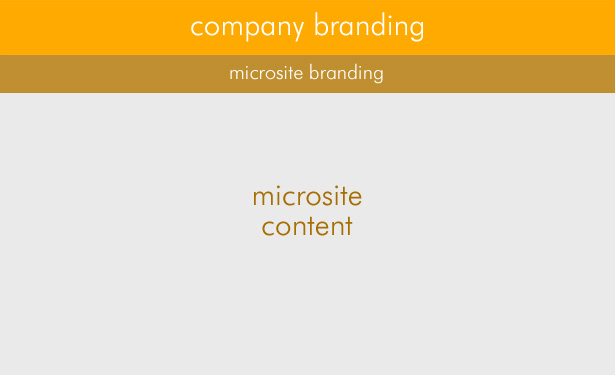
In this first basic layout, we have two characteristics that define the look of the microsite:
- Company (or primary website) branding is featured prominently; thus as a result
- Microsite branding and content are displayed secondary in the layout’s hierarchy
Benefits to Solution 1
- The primary property (the parent company) is clearly defined and therefore marketing benefits for the primary property are enhanced
- The parent website will receive more traffic because its branding (along with a link to the parent website) is featured prominently
Drawbacks to Solution 1
- More difficult to create a clean and inviting design because of having to deal with integration of separate branding for the primary property and the microsite
- Creates confusing usability if there is a primary navigation bar for the parent website and a secondary navigation bar for the microsite
- Branding for the microsite is saturated because it competes visually with primary company branding
Just from reading the benefits and drawbacks I’ve listed (and there are probably others), you can guess that I wouldn’t recommend using this style of layout for a microsite.
A microsite should generally be marketed and branded in a focused manner that draws as much attention as possible to the specific product or service being offered in the microsite. In my opinion, if marketing efforts for the microsite are successful, the parent company will receive natural exposure through the success of the microsite, making the lack of company branding less important in the actual design.
Solution 2: No Secondary Branding
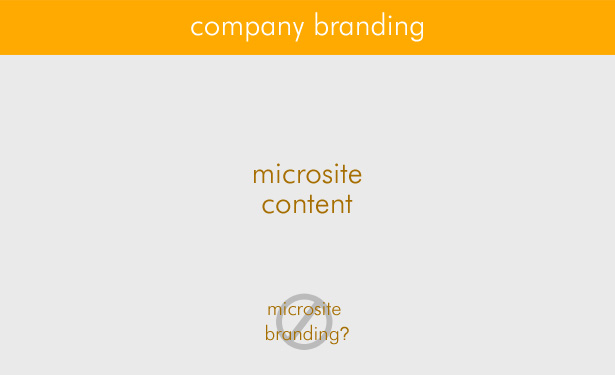
This particular style of microsite layout would have two defining characteristics:
- The only branding is that of the primary property; therefore
- There is no secondary, or microsite-related, branding
This solution is probably the least popular style to choose when designing a microsite, due to some of the factors listed below in the drawbacks.
Benefits to Solution 2
- The primary company’s branding is featured prominently, so there is no confusion as to ownership of the microsite
- A clean design is possible
- Less potential for usability issues
Drawbacks to Solution 2
- The fact that this is a microsite could go essentially unnoticed by the consumer (and some might even say that, technically speaking, this is not a microsite)
- The design will not be unique; therefore
- The marketing of the product or service featured in the microsite will be less effective; and
- The microsite’s branding may not be consistent with promotional material in other media (print, TV)
This solution is unusual for a microsite. If a separate domain name is used for the microsite, the similarities between the company’s primary website and the microsite would cause confusion and create a less memorable experience. If the microsite does not require any unique branding, then it would probably make more sense to just create a secondary page as part of the primary website.
Solution 3: Prominent Microsite Branding
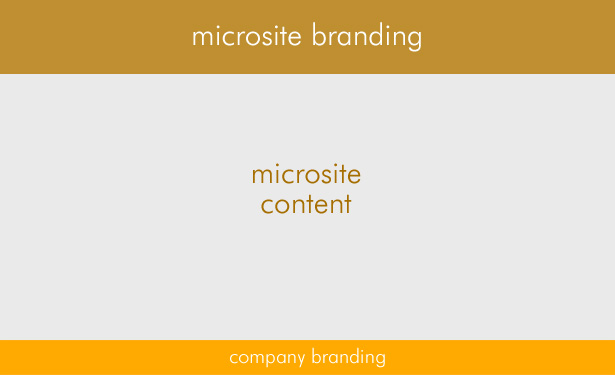
In this solution, the microsite’s individual branding is put above that of the primary company, even though the company branding is still featured in a relatively prominent manner.
Benefits to Solution 3
- More potential for creating a unique and memorable experience
- Marketing benefits for the individual brand of the microsite are enhanced
- The microsite is more likely to be consistent with other media in support of the product or service
Drawbacks to Solution 3
- The primary company branding may go unnoticed by the consumer, creating confusion as to ownership of the microsite
As you can see from the single drawback I’ve listed above, this style of microsite is probably the most successful. The goal of a microsite in virtually all cases is to market a particular product or service. With this style of layout and design, the online presence of the product or service will be more identifiable, and will harmonize better with print materials, TV ads, or other media.
Solution 4: One-Page Promo
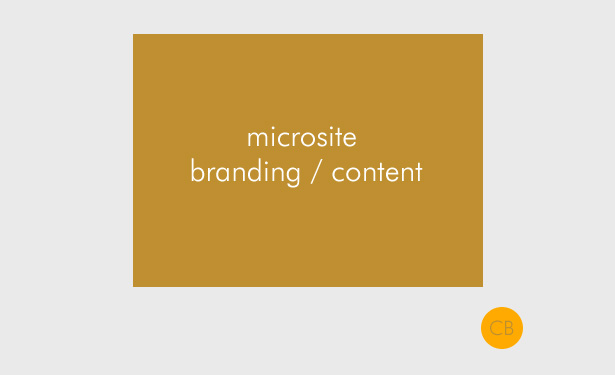
In this solution, the microsite branding is featured prominently, and could take many forms. Although I’ve demonstrated this style using a simple square graphic, it could theoretically be any kind of design.
Benefits to Solution 4
- Branding potential is enhanced
- The likelihood of clickthroughs to the primary property is very high
- Potential for a wide variety of creative possibilities
- Although the primary company branding is featured less prominently, this is less of an issue due to the likelihood of clickthroughs
Drawbacks to Solution 4
- This usually only works for one-page sites or apps, so if the microsite consists of multiple pages, then this may not be a good solution.
This style is popular if the microsite is nothing but a landing page for a particular marketing or pay-per-click campaign. The landing page would then direct the user to the primary company property, so it acts as a sort of super-simple and visually prominent call-to-action (which, to some degree, is true of every microsite). The company branding is still present but minimal, possibly in the form of a small logo in the footer area.
Solution 5: No Company Branding
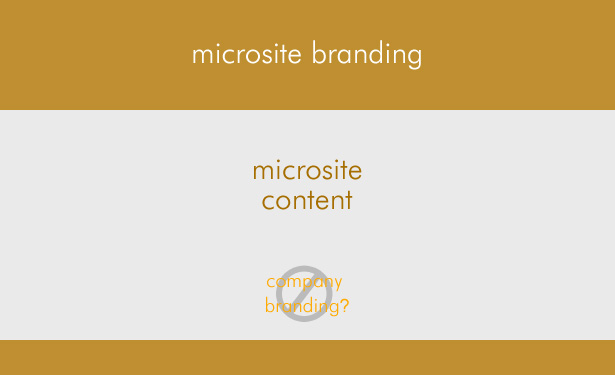
This solution is very popular in microsite design because of the benefits, but it does have its drawbacks. In this style of design, the microsite is designed as a completely different website, usually with its own domain name, and there will be little if any reference to the parent company.
Benefits to Solution 5
- Lots of creative freedom; thus creating a unique and memorable experience
- The microsite brand becomes easily identifiable
Drawbacks to Solution 5
- The primary brand goes virtually unnoticed
- Clickthroughs to the primary website will be minimal or nonexistent
If the purpose of the microsite is to create a unique experience for a particular product or service, and branding and advertising of the primary company is not a factor, then this is a good choice. This type of microsite is likely very popular among designers because of the potential for creativity.
Conclusion
Overall, I think the third solution is the best option in many circumstances for the design and layout of a microsite. But, as mentioned, due to the overwhelming number of potential factors involved, no definite statements can be made in this area as to what is best practice.
The third solution, however, satisfies some of the most basic needs of any website, not just a microsite: It helps enhance the brand of the product or service being featured, it clearly identifies and offers secondary-level branding of the parent company, and it doesn’t hinder the potential for creating a unique experience. The other solutions fail to accomplish one or more of those basic goals.
As an interesting side point to this topic, a microsite created primarily using Flash would be acceptable in many circumstances, potentially creating a very unique and memorable experience.
There are a number of other factors related to the design and marketing of microsites that I could have discussed in this article. My intent here was not to do an extensive dissertation on microsite design, but to provide a simple discussion of some of the most common microsite layouts, and what benefits each has in relation to the potential success of the product or service being offered, as well as the potential exposure of the parent company.
This post was written exclusively for Webdesigner Depot by Louis Lazaris, a freelance writer and web developer. Louis runs Impressive Webs where he posts articles and tutorials on web design. You can follow Louis on Twitter or get in touch with him through his website.
Which solution(s) would be most appropriate for designing a microsite? Share your thoughts below…

Not Useless: Why Experimental Websites Matter More Than You Think
Every once in a while, a site comes along that makes you pause, grin, and think: Wait—websites can do that? Maybe it’s a portfolio where the cursor morphs into a liquid blob,…
How Aspect Ratios Define Perception, Rhythm, and Flow
Designers talk about color, typography, and hierarchy constantly. But proportion—the silent structure beneath everything—rarely gets the same respect. Every card, photo, video, and module in an interface lives within a…

Token Fatigue: When Abstraction Eats Itself
In theory, design tokens were supposed to save us. They were the missing link between design and code, a neat way to abstract decisions—colors, spacing, typography, motion—into a unified language…

AI as Art Director: Can Machines Develop Taste?
Let’s get this out of the way: AI doesn’t have taste. It has statistics. It knows what’s popular, what’s trending, what’s most likely to earn a double-tap — but it…

Pixel Nostalgia: Why We Miss the 90s Web (Even If It Was Ugly)
It’s easy to laugh at the 90s web now — the blinking GIFs, Comic Sans banners, table layouts held together with duct tape and hope. But beneath all that chaos…
Exciting New Tools for Designers, February 2026
There are so many new – and good – tools for designers out there right now. From tiny bits of artificial intelligence to icons that delight, there’s something to help…